October 10, 2025

Reimagining the Turtle and Luncheons on the Terrace at the Orangeburg County Fine Arts Center

 We had a lovely time last night at the opening celebration of Reimagining the Turtle, our three person exhibition with Olga Yukhno, Susan Livingston and Janet Kozachek at the Orangeburg County Fine Arts Center.  The center opened under new management in August, with the one full-time director wearing many hats. We are lucky to have Kayleigh Vaughn, whose previous administrative experience includes her work in education at the Columbia Museum of Art.

The Luncheon on the Terrace series has reopened and is in full swing. Tickets are just $15-- a great bargain for lunch! The next two Wednesdays will include artists giving tours of the exhibition. 


September 30, 2025

The Other Side of the Tortoise Mosaic Installation

 Reimagining the Turtle, an exhibition featuring the work of Olga Yukhno, Susan Livingston and Janet Kozachek, will be opening soon at the Orangeburg County Fine Arts Center here in Orangeburg, SC.  My installation of nine mosaic panels will make its debut there October 8. The Other Side of the Tortoise, an installation of nine mosaic panels, is a study in duality inspired by my memory of a crucifix in a cathedral in southern France. The crucifix was squared off by incorporating non-western artifacts inserted into the four corner spaces outside a central cross. Although this may have been an expression of religious hegemony, I felt that it might have also been a secret way to add some lively decoration to the cathedral. Contrasts have always been central in my art work, having lived, worked and studied in various cultures. In my mosaic panels, the opposites include: hands vs. faces and flora, the inside of the tortoise shell vs. the outside upper carapace, limited color palettes vs. a keyed up one, ancient Chinese scripts vs. Roman protomes. 


September 4, 2025

 Reimagining the Turtle

Across cultures and centuries, turtles have carried powerful meanings. They are symbols of the earth, of endurance, of cosmic balance, and of renewal. In Asian traditions, the turtle embodies the connection between heaven and earth, while many Native American communities regard the turtle as sacred, representing Grandmother Earth and marking time with the patterns of its shell. These enduring associations highlight the turtle as a universal emblem of patience, resilience, and the cycle of life.

In Reimagining the Turtle, artists Janet Kozachek, Susan Livingston, and Olga Yukhno offer their own creative interpretations of this timeless figure. Through sculpture, fiber, and mixed media, they explore the turtle as both subject and metaphor, once ancient and ever new. For some, the turtle’s shell becomes a site of design and storytelling, its form a natural geometry inviting reflection. Others emphasize the fragility of life, transforming the shell into a poignant reminder of loss and transience. Still others celebrate the turtle’s journey, from nest to ocean, as a living emblem of hope and renewal.

Together, these works invite us to pause, reflect, and consider the deep connections between nature, spirit, and imagination. They remind us that even in our fast-paced world, the turtle continues to carry stories worth reimagining.

This exhibition will run through the end of this year, 2025. The reception for the artists will be the evening of October 9 from 6 - 8PM  at the Orangeburg County Fine Arts Center in Orangeburg, South Carolina.


June 9, 2023

A Small Observation on the Minoan Snake Goddess in Crete


Late last year, it was my great privilege to be able to visit Crete and see first hand the famous Minoan snake goddesses in the Heraklion Museum. The most often reproduced one of the pair stands about 14 inches high and waves small snakes overhead in her raised hands. She was  heavily restored upon her initial discovery by the archaeologist Sir Arthur Evans in the beginning of the twentieth century. A head and an arm were added, as well as a crown and a cat on her head. Whether this restoration represents her original state is merely a speculative remake is uncertain. I found her sister snake goddess more appealing. She seemed sturdier and more refined. This second, taller goddess is often described as having snakes crawling up her outstretched arms. 

Making a drawing of the snake goddess while standing in front of her on location was a beautiful experience, as was being able to see her from different angles. As I roughed out the patterns in her clothing, the exposed breasts and the elaborate hair wound with serpents, I noticed something I had not seen before in her hands. She held a snake head in one hand and a snake tail in the other. Clearly this indicated to me that she was not having snakes slithering up her arms but was in fact holding one long snake coiled around her body. I could find no comments upon this in the literature thus far and wonder if anyone else has noticed this small but pertinent detail.  


Does one snake firmly held by tail and head make a difference from the perhaps misguided observation that she has snakes crawling up her arms? The former would seem to suggest a kinship with one proposed theory that this Minoan snake goddess may not be a goddess at all but an image of a performer entertaining spectators by charming snakes. A firm grasp of the head and tail would be necessary for such a sport. It is an aggressive stance and not the usually described passive one.

Whatever she is, goddess or entertainer, the Minoan snake goddess, despite her small size, looms large across the millennia. A detailed drawing of her is now part of my portfolio. Of course, I embellished a bit. But if Sir Arthur Evans can make add on then so can I. 

Snakes up both arms:

https://www.khanacademy.org/humanities/ancient-art-civilizations/aegean-art1/minoan/a/snake-goddess

https://greekreporter.com/2022/08/26/minoan-civilization-crete-snake-goddess/

http://arthistoryresources.net/snakegoddess/minoanculture.html

April 5, 2023

A Review of Maria Rybakova's Quaternity

 The daughter of an infamous dictator comes of age in Paris, a Nobel prize winner's spouse's life of sacrifice and suffering, a woman discovers that she is merely a secondary character in a novelist's life: these are just some of the engaging characters in Maria Rybakova's tales from the Carpathian mountains in Romania, Quaternity.  For the full review follow the link:

 https://coloradoreview.colostate.edu/reviews/quaternity-four-novellas-from-the-carpathians/


February 15, 2023

A Book of Bothersome Cats is now Released for Pre-order

 My illustrated book of rhymes for anthropomorphic cats, A Book of Bothersome Cats is now ready for pre-order. This book was largely created last spring, while I was preparing to go to Romania. Follow the link to order a copy. Here is some advance praise from my very generous dust jacket blurb writers: 

“Janet Kozachek dares us to underestimate her. Light verse? Anthropomorphic cats? Listen and look deeply into this beautiful book for all the layers the author has laid for us like gentle surprises. Tucked into corners and borders, the delight lies in the details: Procrastinator Cat’s bedside reading; Bully Cat’s elaborate jacket; the Guru Cat sitting on a rattlesnake; a cigar held in the paw of the floofy Fat Cat; suggestive portraits on Proper Cat’s dining room wall; and my favorite, the marvelous, coiling tunnel to the rabbit underground of Conspiracy Cat.The author sets an expectation for twists at the turn of every page. 

As a polymath and multi-artist, Kozachek has way too much understanding and artistic ammunition to take her magnificently annoying array of cats less seriously. Her book has both softness and claws, and her wry, rhyming wit also holds compassion for human folly.

In the tradition of Eliot and Lear, A Book of Bothersome Cats sent this pandemic reader laughing back to Stanley Kunitz’s more serious concerns. In our darkest days, he advised us, “Live in the layers, not on the litter.” Kozachek’s book howls quietly, with a big, silent grin and a twitching tail that does not go away.” 

– William Epes, founder of the online arts resource group “strand line break,” host of the multi-arts, open mic series Tuesday Duets.


"Janet Kozachek’s A Book of Bothersome Cats, a sequel to her Book of Marvelous Cats, is playful and fun. Its rhymes and colorful feline characters make it seem suited to children, but the foibles and flaws the bothersome cats possess are decidedly adult maladies. Her illustrations, as always, are precise and intricate, inviting long study to encourage appreciation of every detail. Like all cats, the bothersome cats are complicated characters who are nevertheless endearing and well worth getting to know.”

  –  JoAngela Edwins, Ph.D. Professor of English, Francis Marion University.

 Poet Laureate of the Pee Dee Region of South Carolina. Author, Play. Winner of the SC Academy of Authors' Carrie McCray Nickens Poetry Fellowship, Pushcart Prize.


“A famous artist once said that art was a poem without words. A famous poet once said that poets create art with words.  In A Book of Bothersome Cats, Janet Kozachek does both.  I encourage you to buy this book; in fact, buy several and give them as gifts." 

– Al Black, Founder and President of Mind Gravy Poetry, author of I Only Left for Tea and Man with Two Shadows; co-editor of Poets Respond to Race.


February 11, 2023

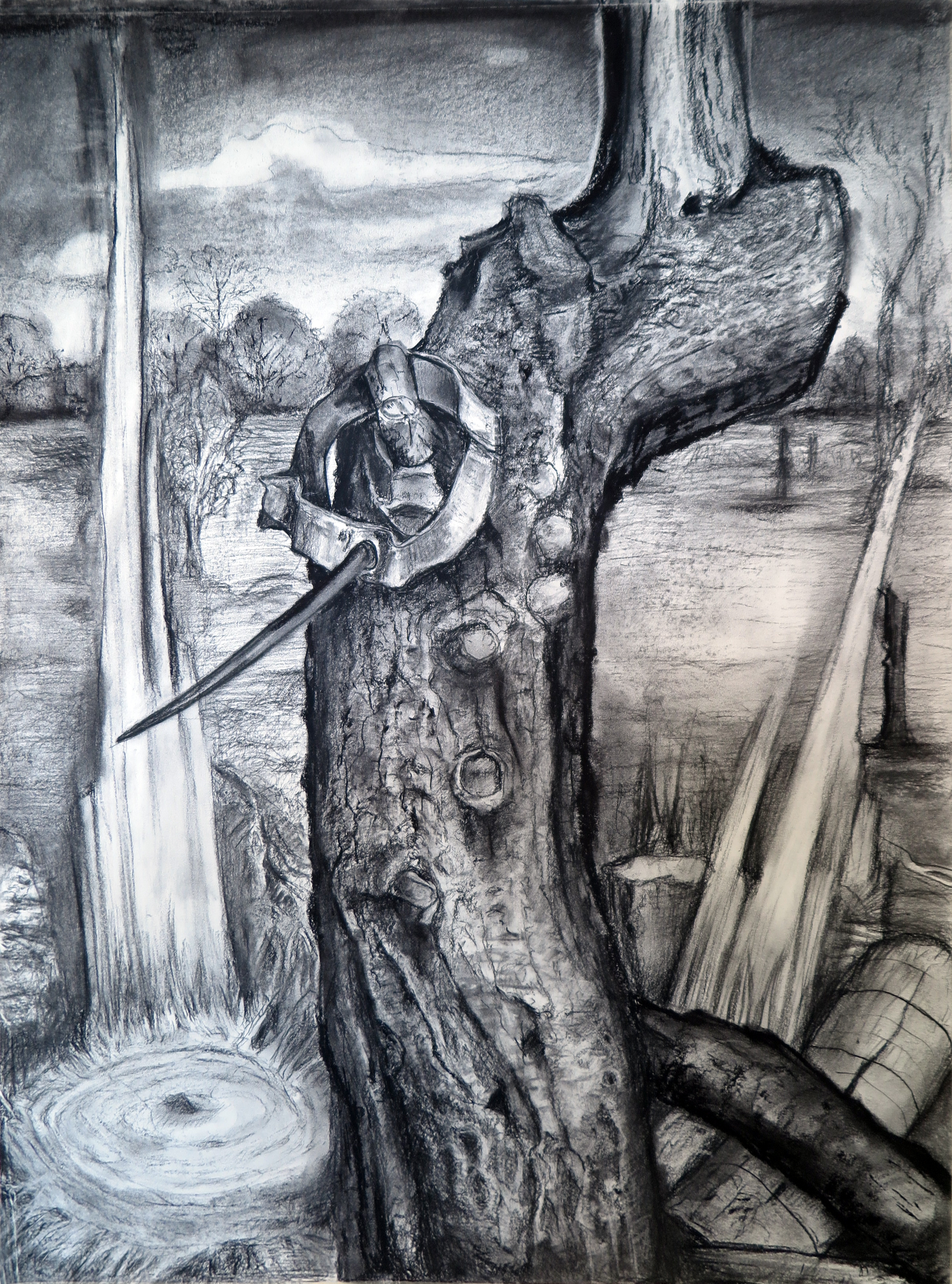
Romanian Stumps in an Orangeburg Field: Charcoal Drawings on Two Continents

 Many artists bravely paint or draw outdoors no matter the weather. I’m not one of them. I do sketch plein air, circumstances permitting, but mostly in order to obtain an impression or idea of a place. The details are then preserved in my cell phone or camera for later reference. There are some benefits to this method, apart from the comfort of creating art in a home studio. Not having the actual object or scene in front of me allows for some imaginative filling in.

These two large charcoal drawings were initially studies of tree stumps that I made in Iasi, Romania. One of the stumps had a strange rusty metal circle and spike attached to it. I could not figure out what its purpose may have originally been, but it most certainly had a threatening look. Was it a defunct instrument for hanging a clothes line? A public art work? Strangely enough, as I saw more such metal attachments to other trees around town it made the latter explanation possible. Some of these impromptu metal sculptures did seem to echo the particular angles of branches. 

I drew the Romanian tree stumps while sitting on the grass until I grew tired and hungry, this effect coming on before my drawing was finished. The drawings weren’t brought out again to finish until my return to Orangeburg, South Carolina. Driving through the countryside in Orangeburg County, my husband and I chanced upon a newly cleared field full of torn stumps and exposed abandoned sheds and homesteads. Needing something for the background for my Romanian tree stumps, I made photographic notes of these and then later applied them to the Romanian scenes. Romanian stumps in an Orangeburg field. Who would even guess? The old canard that people are essentially the same throughout the world also applies to tree stumps. 


January 28, 2023

Ukraine, Art and Poetry in the Times and Democrat Today

 Enjoy today's article in the Times and Democrat

My exhibition will be up until January 31. The Orangeburg County Fine Arts Center and I came up with a nice little exhibition catalogue. Here is an excerpt:


January 25, 2023

The Monkeys in Michelangelo

 The Monkeys in Michelangelo


Many years ago, on a trip to the Louvre, I made sketches of Michelangelo’s famous “Dying Slave.” The statue appeared as a male youth in reverie rather than dying, with a sensuous lifting of his bindings like someone disrobing. What particularly struck my attention was the partially carved monkey at the statue’s base. It was most certainly there, and most assuredly a simian form, but why? Although there have been countless articles written by art historians on Michelangelo’s masterpiece, finding any reference to the monkey has proven elusive. I did find one reference on a blog written by a collective of female southern writers who noted the monkey but did not postulate any reasons for him being there. No need to link here. 

Recently, I revisited the poem I wrote for a painting that I made of Michelangelo’s “Dying Slave.” I had made plans to read the poem for an upcoming performance of poetry and visual art for an online program to air soon this February 28. The painting gave the monkey a prominent place, even adding another monkey for good measure. But the painting was old and looked unresolved upon  closer inspection. It did not go well with the black and white ink and charcoal drawings that I made for our other poems. So I went back to the proverbial drawing board and used ink and charcoal to make an even bolder statement, stylistically matching the other drawings and the theme for our presentation: “A Gentle Unraveling.” 


January 20, 2023

Seven Aspects of Chaos: A Series of Abstract Miniature Paintings Set into Ceramics

 I listened to a lecture by a professor of mathematics in Brasov, Romania. During the course of his talk, he stated that there were “seven aspects of chaos,” in mathematics. The rest of the lecture became a blur, because my mind was transfixed by the phrase “seven aspects of chaos.” The reason for this was that I thought it would make a nice title for seven small abstract paintings. My memory of the traditional Chinese myth about the god Chaos was also prodded to the fore of consciousness. 

The Chinese mythological figure of Chaos, or Hun Dun, was an avuncular being who lacked orifices in this nebulous form. The story goes that over a dinner being hosted by Hun Dun, two other gods felt sorry for Hun Dun and devised a plan to bore holes into him so that he would be able to see, hear, and speak. They bored seven holes over the course of seven days: two for eyes, two for nostrils, two for years and one for a mouth. It always rather stumped me that orifices for the ejection of waste materials were not considered. Maybe that’s why the plan backfired, with poor Hun Dun dying on the seventh day. 

Was there a lesson to be learned about imposing  ill-conceived solutions onto what cannot truly be fathomed or understood? Or maybe the moral of the story was that we should not be to eager to have everyone or everything conform to what might turn out to be arbitrary standards.

In honor of the mathematician, as well as the myth of Hun Dun, My Seven Aspects of Chaos series of paintings was completed this week. These small abstract paintings were set into ceramic frames that I hand carved. When constructing these ambiguously shaped frames, I punched seven holes of various sizes through the clay to reflect the holes punched into Chaos. 

Now the last step will be to name the individual pieces, which I am considering naming after aspects of physics: String Theory, Plasma, etc.  But they can at least finally be seen. 


January 18, 2023

The Final Word on the Last Stone

 Final Words on a Last Rock


In the years from 1983 to 1985, during my studies at the Central Academy of Fine Art in Beijing, a vendor selling rocks from Inner Mongolia would come by the school every six weeks or so to sell his wares. He would lay a cloth out on the open ground onto which he spilled out polished rocks in all shapes, sizes and colors. These all had one side that was flat for the purpose of carving out stamps. The carved stamps, or seals, were an integral part of Chinese painting, so the eager clients for these beautiful stones were the professors of painting and calligraphy at the Academy. 


The stones were marvels of simple artistry, shaped so that they would fit neatly into the grasp of the artist’s hand. Sometimes I missed buying the best examples because I was too dumbfounded by the beautiful display to make an offer while the professors had already begun their bargaining. But the haggling gave me another opportunity, because I never haggled. It wasn’t in me. Whatever the rock seller asked for I gave him, often while the others were still haggling. In this way, over the period of two years I amassed a substantial collection of rocks for seal carving. I carried many of these around in the decades that followed: from China to Holland, from Holland to New Jersey, then finally to South Carolina. 


The traditional Chinese calligraphic form that carvers used for seals was called Zhuan, or seal script. Many of these characters were more pictographic than modern Chinese (modern here meaning about the last two thousand years). The script had originated on ancient Chinese bronzes from the Shang and Zhou dynasties. In 2015 the script was designated a UNESCO world heritage cultural art form.

While many professional seal carvers that I knew had a treasure trove of zhuan characters committed to memory, when carving my own seals I generally relied on textbooks such as the Metal and Stone Dictionary (Jin Shi Da Zi Dian). Every now and then, when I had the occasion, I would carve a stone seal or two and use the prints in my painting. To expand the collection, I added hard linoleum into the mix, but the carving wasn’t quite as crisp as the rock carving, nor was there the allure of the rock itself as an art object. 

After so many decades of carving, the collection that began with the vendor from Inner Mongolia came to its inevitable conclusion. I had at long last come to the end of my collection of uncarved rocks. That last uncarved rock was a milky white pleasingly curved beauty. It felt good to hold. But what to write on it? Should not those final words be a suitable summation of the long rocky journey? 

Initially, I was inspired from looking at an exhibition by modern calligraphers at Yale, to carve only a picture on this last rock. There was an artist in this exhibition, Yi Qian, who carved nothing more than his own face into the rock, stamping his identity onto his work using a visual portrait rather than a signature in ancient script. So I designed a stylized drawing of my long face and large eyes for this last rock. But I could not resist the desire to fashion some script into the hair. It took a while before settling on what would be the final words. The phrase “Final Word,” seemed to be the ideal choice. It helped that the zhuan style calligraphy form for “final,” or “hou” had the appearance of a braid. Reading more about this form, I found that it had a secondary meaning of “queen.” The last rock is pictured below.  


January 16, 2023

An Exhibition of Paintings and Drawings at the Orangeburg Arts Center

 At long last, I’ve decided to attend to my nearly fallow blog to mention my current exhibition at the Orangeburg Arts Center here in Orangeburg, South Carolina. This has been an adventurous year since I last wrote. I spent a month in Romania then returned for the summer, bringing Covid-19 home as an unwelcome souvenir. I had an exhibition and book signing for my full length poetry book, A Rendering of Soliloquies: Figures Painted in Spots of Time, at Stormwater Studios in Columbia, South Carolina. Then it was back to Romania for the autumn semester.

Despite the fact that my Fulbright scholar husband was the main event for us at Alexandru Ioan Cuza University in Iasi, the professors there offered me an opportunity to speak about my own books and art. It was fun and challenging to give a short introduction in Romanian. I will miss Iasi – especially the performances at the local neo-classical opera house. 

You can read more about the exhibition in the Times & Democrat: https://thetandd.com/news/local/orangeburg-artist-brings-together-images-and-poetry-ukrainian-family-history-shared-amid-concerns/article_e648fd36-3afd-5e92-9522-165b16512b6c.html#tracking-source=home-top-story


May 10, 2022

 Sad to see that this was cancelled!

I will be teaching Chinese Calligraphy again in person at Common Ground on the Hill at McDaniel College in Westminster, Maryland.  This will be the first in person meeting since the pandemic hit in 2020.  And it will be the first time for me to teach in person at Common Ground since 2011.  I had managed to teach virtually last summer.  It was my first (and maybe my last) zoom course, and, although it was awkward I got through it.  Zoom had its benefits, though, as it allowed a friend from the west coast to participate.  Follow the link to register. I will be teaching Chinese Calligraphy again in person at Common Ground on the Hill at McDaniel College in Westminster, Maryland.  This will be the first in person meeting since the pandemic hit in 2020.  And it will be the first time for me to teach in person at Common Ground since 2011.  I had managed to teach virtually last summer.  It was my first (and maybe my last) zoom course, and, although it was awkward I got through it.  Zoom had its benefits, though, as it allowed a friend from the west coast to participate.  Follow the link to register. https://www.commongroundonthehill.org/classes/chinese-calligraphy

February 22, 2022

 This will be the first in person lecture in about a year.  I'll be discussing how Chinese language and poetry has influenced my work.  Many thanks to the Poetry Society of South Carolina for helping to sponsor this event. 


November 7, 2021

Lost, Found, and Remade Pit Fired Ocarinas


This autumn, my ceramic work has alternated between the glossy and decorative and the austere and natural.  For some time now, I’ve been working on increasing the range of my ceramic ocarinas - which have been pit fired in the austere, zen-like mode.  The examples here were made with some leftover raku clay.  The raku clay was heavily textured with grog in order to withstand the thermal shock of sudden temperature fluctuations.  This is not really necessary for pit fired ceramics, but I had a bag of raku clay that I wanted to use up, so decided to experiment.

These large ocarinas were made in response to a little mishap, in which a box of pit fired ocarinas went missing from the last exhibition venue.  The center was absolutely certain that they weren’t there and I was absolutely exhausted turning my house and studio upside-down in search of a box that I knew was not there.  At one point, I thought that my hapless husband, who was doing a massive amount of recycling, might have accidentally tossed the box into the bin.

If the box had gone missing under ordinary circumstances, like just a recently exhibited collection of things that was being returned, then things would be disappointing but otherwise not bruising.  But contained in this missing box were two ocarinas that had been purchased, with clients eagerly looking forward to them being shipped.  I offered substitutes, but my clients really wanted the specific art that they had purchased.


A few more weeks went by, and the box of ocarinas did not appear.  So I resigned myself to creating new ones, making one as close as I could to the sold but missing one.  For the rest, experimentation on the raku clay yielded some interesting results.  Since the clay was already pitted and textured, I splattered on terra sigillata, oxides, and mica chips - giving the forms the impression that they were hewn from rocks - or perhaps were found cobblestones that you can just happen to blow into and produce songs.


Just for fun, I pressed into the wet clay forms to shape them to my grasp, making them quite comfortable to hold.  This one was painted with designs reminiscent of Pre-Columbian the burnished ceramic vessels that I had enjoyed seeing in museum collections.

A friend and I put all the bisqued ocarinas into a pit fire, added some salt and copper carbonate and stoked a fire.  The fire ended up not being quite reduced enough with the smothering, so I had to bake a second time and smother again  - the air got to it!

In the mean time, the missing box of ocarinas was found, and now I have a new collection of ceramic ocarinas of many shapes and sizes to dispense with.


October 28, 2021

A Rendering of Soliloquies - Figures Painted in Spots of Time

 Finally!  My full length poetry book is published and available.  This concludes a few decades of additions, subtractions and revisions.  Many of the people who originally posed for the paintings and drawings have grown old, some passed away, and children have grown and move up and onwards in the world.  So this picture book has in some respects taken on an elegiac quality.  I am not certain now whether to call it a well polished work or a seasoned one.  Here is the link: https://www.finishinglinepress.com/product/a-rendering-of-soliloquies-by-janet-kozachek/


There are over fifty drawings and paintings in the book.  With so many, it was difficult to choose one for the cover.  My husband encouraged me to go with something red.  So the painting "The Red Shirt" now graces the cover.


July 24, 2021

 The exhibition, Artists Drawing Artists, opens today at Stormwater Studios in Columbia, SC.  This was a really fun exhibition to prepare for.  Artists paired up and exchanged photographs of themselves.  Many of the artists knew each other so were able to creatively incorporate personal life and art themes into the final portraits.  The portrait that Jeri Burdick did of me, for instance, alludes to my monumental snake paintings.  My portrait of Jeri included a tongue-in-cheek references to the weirder photos that I had sent of myself to her.  The background in Jeri's portrait is embellished with Jeri's free style brushwork.  These portraits made the local news! https://wach.com/features/arts-wach/artists-drawing-artists-stormwater-studios-exhibition?fbclid=IwAR2QRaaGVrjBS3hSOOw-KsQ6mrVqgJb5GBtjakO_4DHJBqhVHRTRfIWkDIs


June 23, 2021


 Yesterday I was interviewed by the New York Parrot regarding my previously published books, The Book of Marvelous Cats, and My Women, My Monsters. We also discussed my upcoming full length poetry collection, A Rendering of Soliloquies, Figures Painted in Spots of Time.  Many thanks to my publisher, Finishing Line Press, for helping to arrange this.  Enjoy the talk and a view of my art-cluttered studio: https://www.youtube.com/watch?v=KvcJgdsDIbk


May 27, 2021

Paper and Steel: Three Versions of "Initiate" and a Poem by Tamara Miles


  On of my tiny drawings, entitled “Initiate,” was selected as part of the brochure for Paper and Steel. But try as I might, I could not locate this drawing.  As the time to hang  this exhibition drew near, I figured that the only solution to the dilemma of the lost work was to draw it over again.  The first drawing was a mere 4" x 6,” so I decided to make the copy 9" x 12,” which better suited its place among the other 9" x 12" charcoal and ink paintings.  So this was hung with the rest of the exhibitions of calligraphic dancers, and I never mentioned that this was a replacement.

Then news came of a small painting that I had made from the sketch, also 4" x 6.”  This color version was sold at the Artists for Africa exhibition.  My donation made me feel a little less useless as an artist and someone in Africa will get needed food, shelter and clothing - perhaps even a dance scholarship.


The night of the Ekphrastic Poetry Reading at Paper and Steel came next.  The poet Tamara Miles selected the drawing of Initiate to write for.  Ah! I thought.  Good thing that I replaced this drawing.  The new drawing, was a bit more lively than the original drawing but not quite as fancy as the painting.  Dr. Miles gave an outstanding performance of her moving poem, which she is graciously sharing for this blog post and other social media.  The poem will be attached to the wall near the painting so it can be appreciated in person.  Paper and Steel will be on exhibit at the Orangeburg County Fine Arts Center until June 30.  


Initiate

-Tamara Miles, after a drawing by Janet Kozachek


To begin, I raise my arms

In perfect praise


to be introduced,

a spark flown

from the initiator’s hand --


and if I learn the way of peace,

an operatic sway,


what promises are made to me?


Just one: You’ll never be the same,


as wild ones once are tamed,

and wild no more.


This ceremony seals,

a holy spirit steals

our names.


An oogenesis occurs --

where we were, 

someone newborn.


Whatever oath was asked,

we’ve sworn.


May 25, 2021

Paper and Steel: An Ekphrastic Poetry Reading by Mind Gravy Poetry


 The ekphrastic poetry reading by Mind Gravy Poetry was a moving tribute to the art work in the exhibition Paper and Steel, at the Orangeburg County Fine Arts Center.  Mind Gravy always does a great job with this.  In my previous blog, I wrote a short review of Derek Berry's recent publication, Glitter Husk.  At the poetry reading a week ago, Derek chose my drawing, Conspiracy Theories, to write and perform for.  It was a tiny 5" x 7" charcoal drawing, but it caught his attention.  Mr. Berry has graciously allowed me to share his composition for the art work: 

conspiracy theories, after janet kozachek


what must god have felt

when the floodwaters crammed

the lungs of non-believers?

what must have noah’s sons

thought when their friends drowned,

mud and blood and screaming

in the rush of water, the image

of god a turned back,

a night sky? did they whisper

to one another of cruelty?

empathy? or did they cluck

their tongues at those

who had named the dark clouds a conspiracy?

there must be some moment

when children look at their fathers

and understand they are also sons,

when they understand their parents

cannot answer for god.


on facebook, the mother of my childhood best friend

implores her friends to abandon ship.

they will no longer put up with the fake news,

the stolen election, the wicked vaccines,

the homosexual agenda, the millennial generation,

the microchips, the freudian slips,

the children in cages or the children in basements,

the children learning about evolution in schools,

the children who will grow up to one day hate them

for all they do not believe to be true.


i too have huddled with friends

in smoky rooms and asked the questions

about the cia, the man, the medical establishment,

the history not taught in schools, the slaughters forgotten,

the unions busted, the god written and rewritten

into thousands of books, then painted white

and hung on a plastic cross hanging from the neck

of the mother of my childhood best friend,

who believes i’m the enemy.


i do not how to trust anymore.

i do not know how to point to the truth

& say, “this is the truth,” without flinching

at everything i do not know.

i do not know how to ask god, “why?”

without wondering when my children will ask me the same question.


but i know i touch my lover’s

face with the same hands

once cradled in the palms

of that woman, who once fed me,

who once when i was a toddler,

kept me alive for three days

while my brother was born premature in the hospital.

a woman who loved me, in a way,

until i grew up to become one of the drowned.