
March 22, 2020
Common Ground on the Hill - A Long Awaited Return
In this time of cancellations and closures, it is good to hear today that some things are still on! My course in ink and pencil book illustration, Ink, Silk, Pencil, Paper, is open for registration on the Common Ground on the Hill website. The course runs July 5 - 10, from 9 am - 10:15 am. I will be teaching the ink on silk imperial style Chinese painting method and how I have adapted that to pencil and paper for illustrating my poetry books. This is a really fun summer camp where artists, musicians, writers, poets, and dancers from all over the world converge once a year in this spectacular celebration of the arts. This will be my first time teaching here again after an hiatus of ten years. I'm looking forward to it. Follow the link here to register: https://www.commongroundonthehill.org/
 Illustration for Woodland Harmonies, by Kristina Miller. Unpublished manuscript.


March 8, 2020
Photography at the Orangeburg County Fine Arts Center

The Photography Exhibition, A Few of My Favorites: People, Places, Times and Spaces, is on view now at the Orangeburg County Fine Arts Center. The opening reception will be this Thursday evening, March 12, 2020, from 6pm - 7:30 pm.
Photography at its best satisfies our wanderlust for other places and reveals to us as well the wonders found in the spaces within our everyday worlds. The art of photography is about place, timing, and the artist’s eye. It is an art of presence and patience - about knowing exactly when and where to snap that shutter. The photographer, alert to beauty and meaning, awaits for moments when both of these converge in the natural world. Their steady hands and aesthetic gaze preserves their presence in those moments. This exquisite sense of presence can be found in awe-inspiring vistas, such as the snow covered peaks of Norway in the art of Nathaniel Wallace, and in the sublime night view of the United States Capitol in the poignant photograph by Bill Carter. We are inescapably present in the artists’ intimate views as well. A pair of working hands with fingernails painted like gems of blue lapis are gently offset by a red handled pair of scissors in Bill Carter’s subtle, yet poignant work. Wallace finds a beautiful moment in a store window in the Netherlands, when a calico cat crouches to unknowingly echo the shapes and colors of the art print that it presides over.
The exhibition, A Few of My Favorities: People, Places, Times and Spaces, is an exploration of unmanipulated or minimally manipulated reflections of observed environments. Nat Wallace’s haunting scenes of weathered buildings and abandoned farmsteads around the Southeast record the effects of nature and time upon man-made objects. Bill Carter captures the spirit and mood of everyday people as well as the intellect of iconic individuals. Both artists depend upon serendipity, exploration, and intuition in their photography. Through their evocative art, their photographs invite an internal narrative between viewer and image. These are images that eschewed the world of snapshots and sound bites, encouraging quiet contemplation and taking the time to observe and reflect.
March 7, 2020
A Seat at the Table: The Chair as Aesthetic and Social Construct. The Ekphrastic Poetry Reading
 The opening of our four-person exhibition at the Bassett Gallery at the Fine Arts Center of Kershaw County in Camden, South Carolina was graced by an ekphrastic poetry reading by Mind Gravy poetry. This group of latter day troubadours collaborates with visual artists to compose poetry and music in homage to the exhibited work. The following poem was composed by Tamara Miles and was influenced by both the sculptural chairs of Lee Malerich as well as my painting, Cold Morning.
 Primitive
by Tamara Miles
Winter in Holland, accented
open space, cast off, tumbled chairs
that trace to our ancestral days.
Storied evolution of seats -
folk culture, anthropology -
throne or rocker, high wooden stool,
 chair from which a chaperone stares,
each formed with a creative bent
to tender our hours quiet,
spent alone or near our dearest.
Out here, ghosts claim the catbird seat,
immutable, secure, they stay.
I do not dare to seal these chairs,
nor set them right or bear away
what seems to be abandoned now.
The ancients see it so and smile.
Pawed feet, the chairs may come alive,
in rhythms of their own arise,
and take as dancing partners trees.
I think I see their silhouettes -
The gods of furniture design
surprised to see their chairs grown wild.

February 28, 2020
Skelton, Bai Juyi, and a Parrot Lost in Translation

The large charcoal drawing, Parrot Lost in Translation, was just completed as a center panel for my triptych on the theme of bondage. The drawing bookmarks two poems that I had studied from different eras and written by poets who were the products of very different cultures. The first one is a fragment of the poem, Speke Parrot, by the sixteenth century British poet and tutor to King Henry VIII, John Skelton. The second poem, The Red Parrot, is by the Tang poet, Bai Juyi.
Completing this drawing forced me to revisit old history and rusty skills. As a young woman, I studied calligraphy as part of my graphic design courses and once made a calligraphy piece in ink based upon Skelton’s satirical poem Speke Parrot. I searched for this decades old piece and found it still intact in a dusty folio. In my new drawing, however, I reproduced it not in ink, but in charcoal, substituting a different initial for the one in the original piece of calligraphy. This proved to be a painstakingly slow task. Plodding work does have its benefits, though. While delineating these letters in dark charcoal, my mind was free to recall another poem that I had learned as a graduate student in China, Bai juyi’s Red Parrot. I could still recite the poem and write most of it in Chinese, but could not quite recall some of the characters. A search online revealed only the Arthur Whaley English translation, which drove me to even more consternation because this was such a loose translation that the essential meaning was probably lost.
My Chinese keyboard was lost when transferring to a new computer, so unfortunately I could not search online the way I needed to. But my Chinese friends and colleagues came to the rescue, when I simply sent them my written notes of what I remembered of the poem in Chinese. Most of my friends remembered instantly and supplied me with the missing characters or linked to an original language posting.
Just as I thought, the Whaley translation differed from the original in some key points. The Whaley translation of Bai Juyi’s poem goes like this:
The Red Cockatoo
Sent as a present from Annam -
A red cockatoo
Coloured like a peach-tree blossom,
Speaking with the speech of men.
And they did to it what is always done
To the learned and eloquent.
They took a cage with stout bars
And shut it up inside
Thus lies the problem. In the original Chinese version, there was no cockatoo, but a parrot. There was no present or gift. There was no directly referenced anthropomorphous "learned" and "eloquent" creature. And there were no mysterious authorities taking said creature and locking it into a cage with stout bars. The two center lines "Coloured like a peach-tree blossom. Speaking with the speech of men," is truer to the original.
 As a substitute for my lack of a Chinese keyboard, I can just post the calligraphy here, I suppose, and present it without the early twentieth century gloss. I am not exactly an expert in classical Tang Dynasty poetry, so there may be some subtleties that I am missing. But here is what the poem plainly says. I’m putting "it’s in parentheses because there is no gender in the original:
An nan, near and far
(There is) a red parrot
(It’s) color like a peach blossom
(It’s) words like a person
(It’s) thesis (or written articles)
compiled excellently
When will it exit
(It’s) cage obtain a (free) life?
Perhaps then, there is an alternative reading of the poem from what English speakers are allowed to access. This is not something that I can prove without research, but could it be that when Whaley was translating The Red Parrot, he was actually thinking of Skelton? Skelton’s parrot was a gift, and was certainly taken out of and put back into a cage. Skelton’s parrot was also ostensibly a parody about Cardinal Woolsey.
Although The Red Parrot does not explicitly state that Parrot is, in fact, a learned person, it might be safe to conjecture that Bai Juyi, like Skelton, meant the parrot to represent a particular person, or a particular type of person. What parrot writes articles?
It is those last two lines, however, that are ambiguous. We don’t really know if Parrot is being willfully restrained in a cage, or if he wishes to stay there. Could it possibly be the latter? I suspect that this is possible because historians tell us that Bai Juyi wrote in a vernacular style that was accessible to ordinary people. Might he have been satirizing the practice of his contemporary poets to over-intellectualize their poetry? Was he criticizing constraint over freedom? Style over substance? Obfuscation over clarity? Furthermore, it begs the question as to whether or not Bai Juyi was considered a potent critic of government not because of his intellectual acumen, but because his criticism was leveled in terms which everyone could understand.
February 24, 2020
A Seat at the Table Exhibition Coming to the Bassett Gallery in Camden
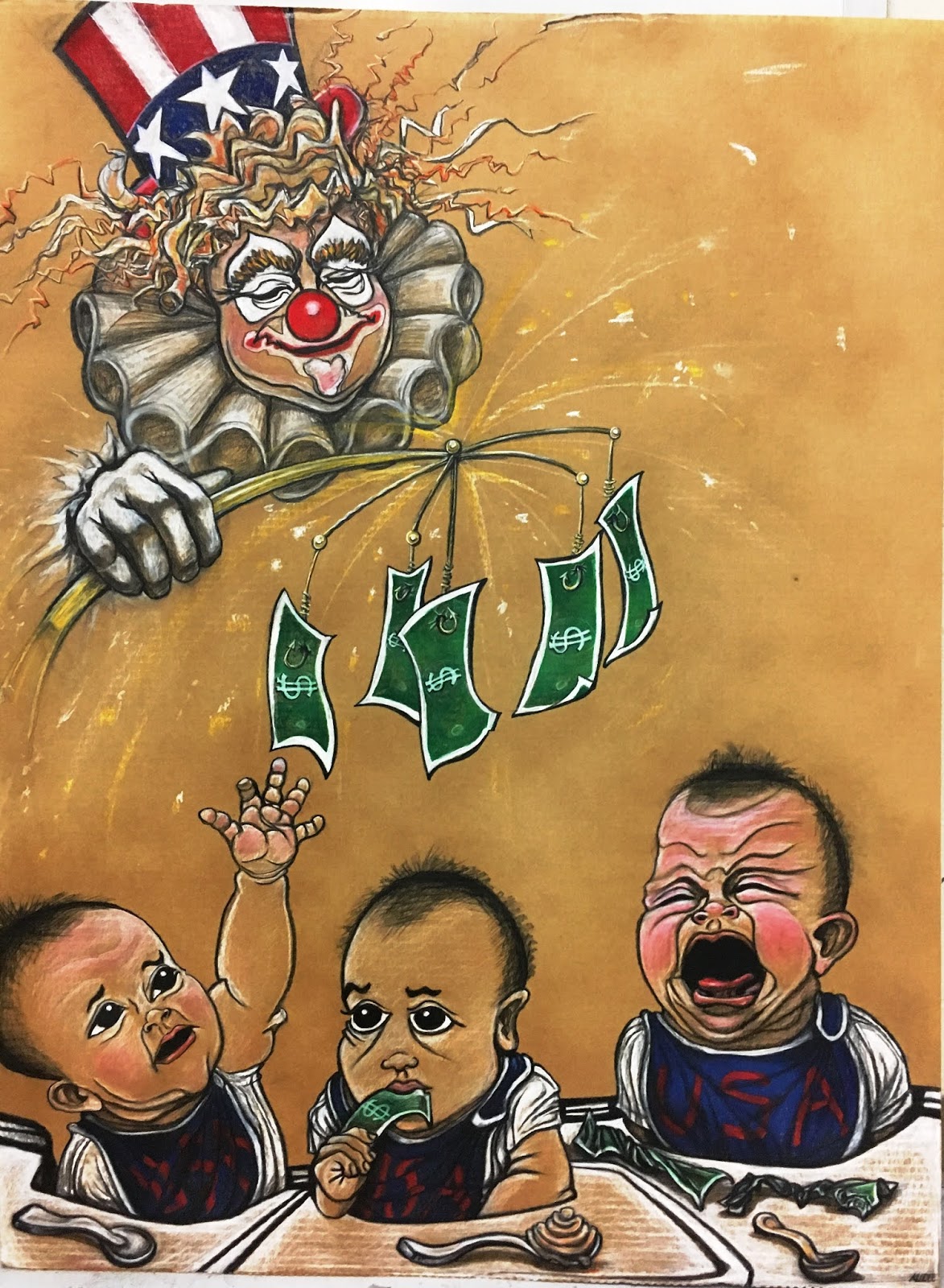 One exhibitioin Spartanburg is drawing to a close as we’re preparing to move on to our second venue. A Seat at the Table: The Chair as Aesthetic and Social Construct, will travel to the Bassett Gallery at the Fine Arts Center of Kershaw County on March 5. At this next venue we will add a new artist, Professor Kim Ledee. We will also be enlivening this space with new pieces from our ongoing work. Modules, multiples, diptychs and triptychs will predominate this time. Professor Ledee raises social consciousness through art that addresses growing income inequity and the slowing pace of social mobility in the United States in her diptych, American Dream/American Nightmare.
 My own work will be taking a somber turn from the whimsical art in the previous exhibition with my triptych on the theme of bondage. My first chair in this triptych, posted earlier, has a roll of tape on the seat. Unfortunately the feedback that I am initially getting on this from viewers is that is looks like a roll of toilet paper. Ah, critics!
 The second chair in this triptych incorporates ropes tied into various configurations. This took a very long time to create, as I decided to actually study and practice different types of knots before setting up the roped chair to draw. I learned how to tie some of these knots by studying photographs of ship’s knots that I had taken earlier at the Charleston Harbor.

These knots were not easy to reproduce by analyzing the pictures, and I am certain that most of these have to be taught by hands one step by step instruction. I did manage to figure out some of the more rudimentary ones, however, and have included a few, such as the cat’s claw, in my drawing.

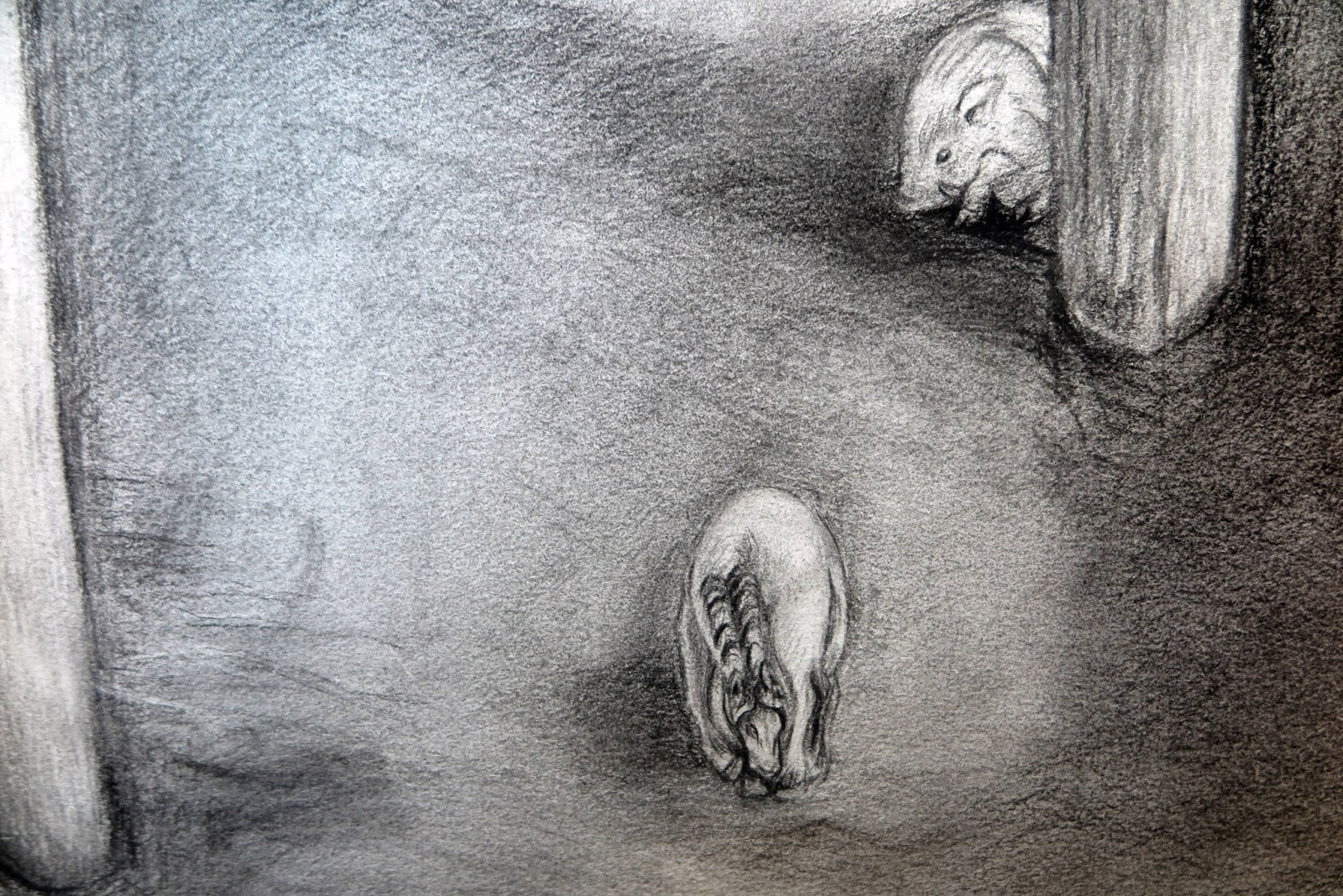 Ultimately I did not adhere to any particular style of knotting for the ropes draped along the chair in my drawing, instead making an agglomeration of the twisted, turned and tied. Because of the loose arrangement of the ropes, the theme may now be less one of bondage, but of something or someone having escaped being tied - hence the new title: “Unbound.”
Strewn throughout the compositions are knots and binders that pay homage to some of the Japanese art that I studied earlier last year. Along the feet of the chair are drawings of Eighteenth century Japanese netsuke, which were used as decorative carvings to attach pouches to sashes. In the upper right corner of the drawing there is a black length of rope with a configuration taken from a detail of bound hawks in an Edo period Japanese screen painting by Soga Nichokuan.
The finished drawing is a very studied piece of art work to be sure.

February 20, 2020
A Seat at the Table: The Chair as Aesthetic and Social Construct - Second Spartanburg Art Walk

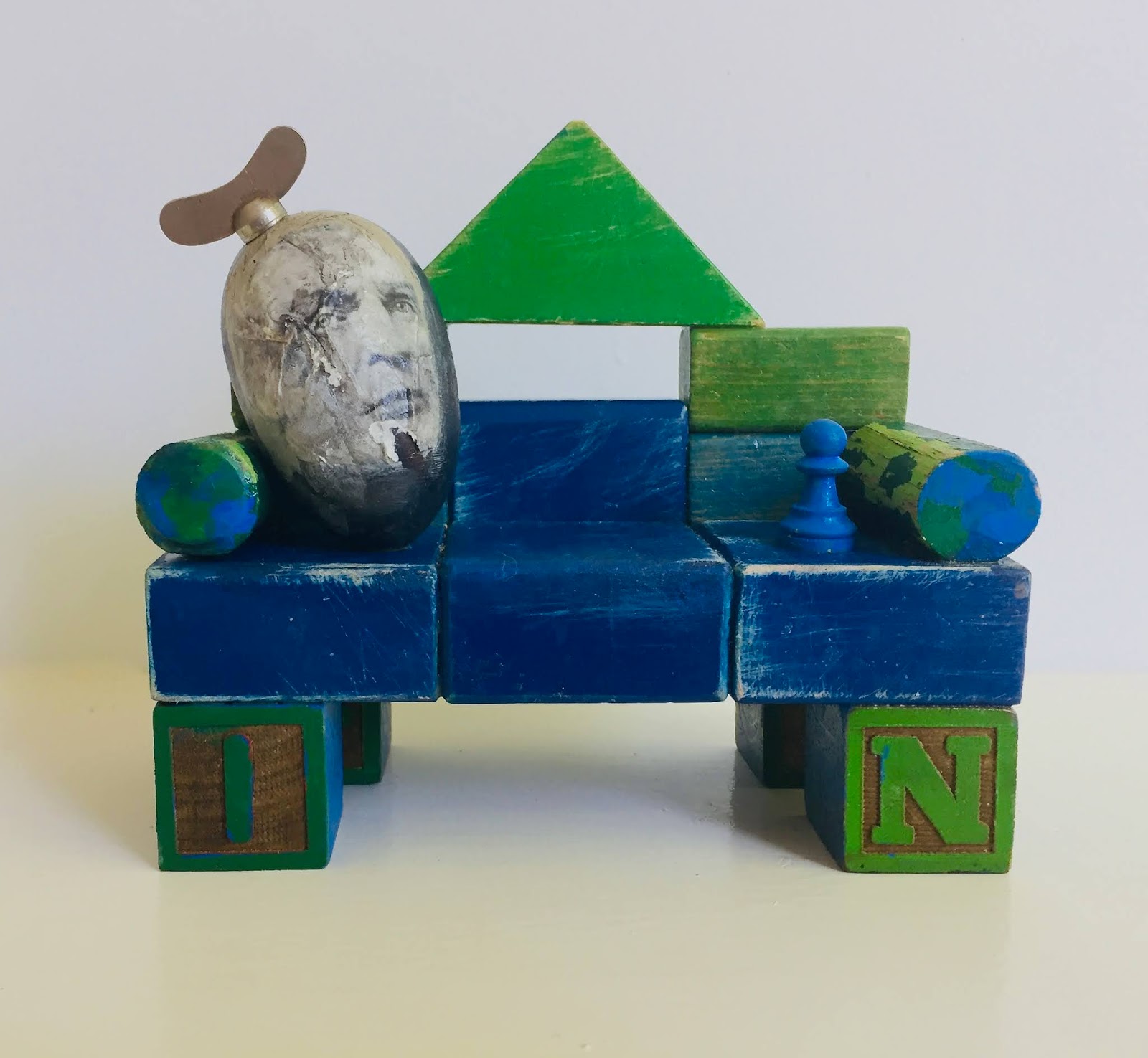
The Doc is In
Check out the exhibition at
February 17, 2020
My Women My Monsters is in Print!

I am also so very thankful for my reviewers: Professor Emeritus Larry Rhu, Professor Janet Walker, and Professor Tamara Miles, for writing such insightful dust jacket blurbs.
Here are the links to the chapbook on Amazon and on the publishers’s website:
https://www.amazon.com/My-Women-Monsters-Janet-Kozachek/dp/1646621425/ref=sr_1_1?keywords=My+Women+My+Monsters+Janet+Kozachek&qid=1581958010&s=books&sr=1-1
https://www.finishinglinepress.com/product/my-women-my-monsters-by-janet-kozachek/
February 16, 2020
A Seat at the Table at the Artists Collective, Spartanburg

On view at:
Artists Collective, Spartanburg
578 West Main Street, Spartanburg, SC 29301
www.westmainartists.org
864 706-2474
January 19, 2020
A Seat at the Table: A Tale of Two Chairs
A Seat at the Table: A Tale of Two Chairs
Artists often like to debate the merits and shortcomings of each other’s genres. Abstract, performance and installation artists might claim to be more cutting edge than those artists devoted to carefully composed studies of objects rendered from direct observation. Purveyors of realism sometimes claim that artists who choose the former modes of expression do so because they lack basic skills. The "modern" or "cutting edge" argument does not exactly hold much credence, because the roots of most abstract, performance and conceptual art has its roots in art movements that are now over a hundred years old. ( Indeed, performance could be considered a few thousand years old!) There are expressive qualities to abstraction, however, offered by freedom from constraints and the possibilities for exploration, which make this pursuit in art refreshingly tempting. The drawing skills argument is also pertinent, however. Although many artists might not admit it, skills not practiced are skills lost.
I work in more than one genre, and as a result see the merits of many alternatives to making art. My abstractions allow for a certain type of expressive brush work that would be difficult to maintain in an art work that relies upon carefully delineated forms based on observable reality. I must admit, however, the truth that not keeping in practice drawing from nature does indeed result in an erosion of that skill. I noticed this recently when making large drawings for an exhibition on the theme of chairs.
I had been spending a significant amount of time writing, marketing, and applying for professional opportunities. A number of weeks went by and I had not put brush to canvas and pencil to paper. When this happens, I find that sitting down and applying myself to making art again can be rough and rusty.
 Generally, when attempting to get back into practice, it is a good idea to start small. Drawing from life is basically an ability to transfer, in increments of held visual memory, a three-dimensional object onto to two-dimensional surface. Even for the trained artist, it is Not easy. And the larger the object transferred, the more difficult the task. Therefore jumping right in to making life size renderings of chairs on large pieces of paper resulted in some false starts.
 In my first attempt, my out -of- practice sense of perspective and proportions kept causing distortions in my drawing. What resulted, however, was a dark picture that had some nice expressive qualities. At that point I had to make a decision about whether or not I would keep those efforts. I decided to be honest with myself and admit that the results were not entirely what I had originally intended. So I dispatched with the drawing along with all the hours of time put into it, and started over. I made tracings of my first attempt and transferred this onto a new sheet of paper, lifting the form higher up on the page. I set to work rendering the chair from life, deliberately and slowly. In the weeks that followed, I had a stronger form. Not perfect, but stronger.

Artists often like to debate the merits and shortcomings of each other’s genres. Abstract, performance and installation artists might claim to be more cutting edge than those artists devoted to carefully composed studies of objects rendered from direct observation. Purveyors of realism sometimes claim that artists who choose the former modes of expression do so because they lack basic skills. The "modern" or "cutting edge" argument does not exactly hold much credence, because the roots of most abstract, performance and conceptual art has its roots in art movements that are now over a hundred years old. ( Indeed, performance could be considered a few thousand years old!) There are expressive qualities to abstraction, however, offered by freedom from constraints and the possibilities for exploration, which make this pursuit in art refreshingly tempting. The drawing skills argument is also pertinent, however. Although many artists might not admit it, skills not practiced are skills lost.
I work in more than one genre, and as a result see the merits of many alternatives to making art. My abstractions allow for a certain type of expressive brush work that would be difficult to maintain in an art work that relies upon carefully delineated forms based on observable reality. I must admit, however, the truth that not keeping in practice drawing from nature does indeed result in an erosion of that skill. I noticed this recently when making large drawings for an exhibition on the theme of chairs.
I had been spending a significant amount of time writing, marketing, and applying for professional opportunities. A number of weeks went by and I had not put brush to canvas and pencil to paper. When this happens, I find that sitting down and applying myself to making art again can be rough and rusty.
 Generally, when attempting to get back into practice, it is a good idea to start small. Drawing from life is basically an ability to transfer, in increments of held visual memory, a three-dimensional object onto to two-dimensional surface. Even for the trained artist, it is Not easy. And the larger the object transferred, the more difficult the task. Therefore jumping right in to making life size renderings of chairs on large pieces of paper resulted in some false starts.
 In my first attempt, my out -of- practice sense of perspective and proportions kept causing distortions in my drawing. What resulted, however, was a dark picture that had some nice expressive qualities. At that point I had to make a decision about whether or not I would keep those efforts. I decided to be honest with myself and admit that the results were not entirely what I had originally intended. So I dispatched with the drawing along with all the hours of time put into it, and started over. I made tracings of my first attempt and transferred this onto a new sheet of paper, lifting the form higher up on the page. I set to work rendering the chair from life, deliberately and slowly. In the weeks that followed, I had a stronger form. Not perfect, but stronger.
January 1, 2020
A Seat at the Table: Article in Carolina Arts January 2020
Happy New Year! Carolina Arts is just out with an article about our upcoming exhibition at Spartanburg Artists Cooperative on Main Street. Turn to page nine and eleven for an illustrated overview of the show:
http://www.carolinaarts.com/120/120carolinaarts.html?fbclid=IwAR0zbskwnDoMgOm8O_fB-gifnGmx3f6I51nECVGe8tVT_ljSDU_rhzAemqk
http://www.carolinaarts.com/120/120carolinaarts.html?fbclid=IwAR0zbskwnDoMgOm8O_fB-gifnGmx3f6I51nECVGe8tVT_ljSDU_rhzAemqk
Subscribe to:
Posts (Atom)
