October 5, 2018

The Thug Slug

This autumn finds me working on articles, grant applications and gallery applications. Despite this flurry of literary activity, I managed to carve out a small fragment of time to work on text and illustrations for my book, You Look Great! Making Invisible Disease Visible.  This most recently completed drawing, however, makes a feature of certain connective tissue disorders more svelte than scary.  The skin sign that this picture alludes to is a condition known as striae, or stretch marks.  These are stylized on the subject’s thighs in my drawing, transformed in to something like a decorative tattoo.
This illustration was an amalgam of two completely unrelated observations from nature.  The first one was a model that I drew from a life drawing class many years ago in, of all places, The People’s Republic of China.  The figure’s top half is transformed in to the head of a large black slug, the type which I saw on a trip to the mountains of Norway.  I named the picture “The Thug Slug,” after a comment from a friend when he saw my original picture of the enormous black slug I saw in Norway.  I am not certain if he was referring to the slug’s impressive size, or to the fact that it was an invasive species, but I liked the sound of the phrase “thug slug,” so it stuck.
The phrase “thug slug,” brought to mind a sound that I often here in the Southeastern United States.  It is a southern accent that makes a short “u” elongated and sounding almost Germanic, as if it should have an umlaut over it.  With this in mind, I wrote a rhyme which works exquisitely well if recited in this accent.  I think that I have exhausted the possibilities for words that rhyme with “slug.”
Thug Slug
Thug slug wants to give you a hug hug
and give the skin on your thighs a tug tug
so that they look chaffed upon a rug rug
or the tracks beneath a train that goes chug chug
Thug slug wants to crawl across your mug mug
like a slimy squirmy little bug bug
that squirts goo up your nose to make a plug plug
stuck up so tight and snug snug
that you can only loosen it up with a drug drug
You can make fun of me and act smug smug
But I’ll just laugh it off with a shrug shrug

September 18, 2018

Renewed Still Life Paintings

It has been a long time since a blog post. But I have been active in art. For my most recent paintings I have repainted old still life compositions and added a large new one. Even the new painting was a remake, although the painting underneath was a figure study. The emphasis on tiny black calligraphic lines that delineate areas of intense color breathes new life in to these old compositions.

These three paintings make use of ceramics from our collection. Thus our collection is now legitimized as studio props. The bowl that holds the pears was based upon the pottery of Jeri Burdick. Jeri also created the oblong platter upon which the grapes rest.

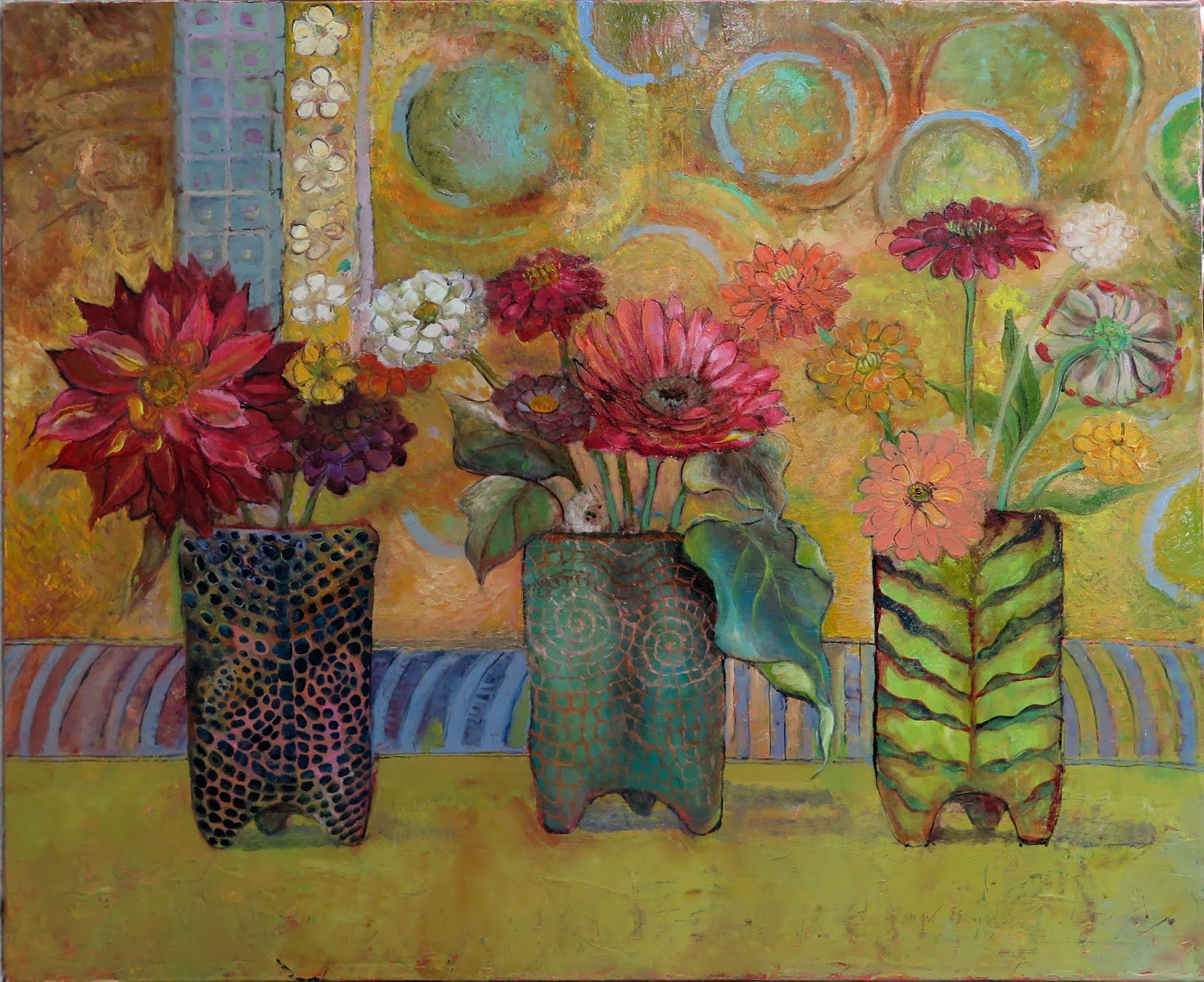
For the largest of the three paintings, I selected the carved porcelains of Michael Sherill. These were acquired at the Blue Spiral Gallery in Asheville, North Carolina. Perhaps these were the most inspiring to use of all. The intense textures and colors suited the freshly harvested dahlias, zinnias and gerber daisies from my garden. The background of this painting preserves much of the original pattern that was present in the figurative painting, although now turned on its side.

August 2, 2018

Doodle Paintings from 1980 Revisited in 2018

In 1980, during my senior year at Douglas college, I was studying with the painter Joan Semmel. Feminism in art was in vogue in the late seventies and the early 1980's. Douglas, the woman’s campus at Rutgers University, was at the forefront of a galvanized interest in historical contributions of women in art as well as inquiry in to the female expressions of contemporary artists. Lucy Lippard and Judy Chicago were the heroines of the day.

On the local college level there were, I recall, exhibitions of collages made of female panties (painties?) and a plethora of art on such themes as menstruation. These were topics that I generally wished not to think about. But I was intrigued by the question of whether or not there was a female approach to abstract painting that differed from their male counterparts. Some claimed that one could deduce the gender of the artist just by looking at an abstract painting. I was not so certain about that but just for fun, decided, with a touch of irreverence, to execute a series of nine abstract paintings on wood panels that would look feminine. I called them "Doodles" because they were based upon the doodles I would freely make in the margins of my notebooks. I figured that anything that was intrinsic in nature would be most likely to emerge from free association. Professor Semmel admitted that she was uncertain as to how to evaluate these stream of consciousness paintings because they were so "quirky."

The paintings were displayed in the college gallery, then taken down and put in to a square box. They remained in that box for 38 years. This past summer, I retrieved them from storage. I almost discarded the entire box. Who wants to be reminded of their callow youth? Yet I decided to take them home with me anyway.

Last week, in an act of plagiarism of my own younger self, I restored, repainted, and re-posted these paintings. Some were just cleaned up a bit. Others were almost completely redone. I then posted the "new" works on social media. Someone wrote in and called them "quirky."

I’ve posted the before and after paintings here, quirky or not, as an interesting comparison between the young woman painter of 1980 and the old woman painter of 2018 who may or may not have learned a few new tricks over time. Having some technical difficulty on posting the revisions, but will try.


In 1980  they looked like this:


July 26, 2018

Pigeons in my Book

There is nothing quite like a little bit of pressure to finish work. I have been working sporadically for two years on my book You Look Great! Making Invisible Disease Visible. Many things got in the way of completing this, both visible and invisible. There was the problem of managing disability itself, with sluggish downtimes and time consuming medical appointments. Then there was the daily distraction of household and property maintenance, as well as my sometimes "real job" of producing art work for galleries that may or may not actually sell it.

The biggest delay in writing my book was the fact that there were two other incomplete books in the pipeline ahead of this one. But those are finished now and I am in the process of sending them out to prospective publishers, getting them back again, and then sending them back out to different places. At my age it is basically a mechanical process.

I actually have two or three other incomplete manuscripts but they will go on the furthest back burner. My incomplete part memoir/part medical adventure/big part illustration text looms over me. This is where applying just a little bit of pressure comes in. A short article for the Mayo Clinic will be published this fall. In this article I casually mention my work on You Look Great! Making Invisible Disease Visible. It helps make the goal of finishing this a bit more real.

I have begun setting a bit of time each day to write and work on illustrations. This last one, Piezogenic Pigeons from the chapter "Barrier Beasts." The rocks were drawn mostly from life and on location in Norway. Loved the vacation but allowed a little bit of pressure to intrude in order to bring my book illustration to life.

July 1, 2018

A Pack of Picky Pinky Panthers

I am back at work illustrating the chapter “Barrier Beasts” for my book “You Look Great! Making Invisible Disease Visible.”  This chapter is a satirical look at the intimidating barriers patients sometimes face in determining diagnoses of illnesses that have no one specific physiological marker, but require an accumulation of several physical manifestations that can be added up and tabulated for a definitive “score.”  This can be seen in such illnesses as Ehlers-Danlos, which a revised nosology added, at least on the Beighton scale, more stringent conditions for diagnosis.  For example, patients could be granted a point on the scale in flexibility for the pinky finger’s ability to bend up to or beyond 90 degrees.  This was changed slightly to read only “Beyond 90 degrees,” the cut off barrier to diagnosis moved just slightly higher. 
My satirical drawing and rhyme for this is called “A Pack of Picky Pinky Panthers.”  The rich background of this drawing is derived from the landscape of Norway, where I am at present.

A Pack of Picky Pinky Panthers

You can raise your pinky to ninety degrees
But you’ve only just begun
To unlock our gates of entry, please
bend little finger to ninety plus one

We have changed our minds, that won’t quite do
Little finger must bend more
It must bend to ninety degrees plus two
Don’t complain it makes you sore

That still does not look right to us
More points you must accrue
Pinky must bend back ninety-nine degrees plus
Or we’ll turn you in to glue

With your palm flat upon a table
bend pinky up to three o’clock
Then we’ll see if you are able
at the same time to lift a rock

Don’t cry and call us panthers mean
We only must be sure
Your pinky should bend to three fifteen
Or we will not allow you through our door

June 27, 2018

The Red Hen Restaurant in Lexington VA: A Real Review from an Ordinary Person who Actually Eats There

The Red Hen Restaurant: A Real Review from an Ordinary Person Who Actually Eats there and not the Fake One from our Government

Twice a year my husband and I make the trek from South Carolina to New Jersey to visit family and friends. We always try to make a stop in the charming town of Lexington, Virginia. Lexington is a jewel box of shops, restaurants, walkways bedecked with flowers, and a small museum that has a nineteenth century style garden. One of the highlights in Lexington for us is the Red Hen Restaurant. Their hours don’t always dovetail with our arrival so it is a treat when we can get in. We go there for the excellent food, manageable prices, and the pleasant atmosphere. The place is well decorated with the accouterments of local crafts, such as the beautiful wrought iron instruments hung by the staircase. The establishment is impeccably clean, and brightly colored with tastefully selected paints. The service has always been reasonably on time and professionally accommodating. I am an ordinary person with little power or influence.

What happened recently is that a woman who was not so anonymous, Sarah Huckabee Sanders, who represents the power of the American Government, decided to visit this restaurant with her entourage. According to news sources, the staff expressed consternation over her presence on account of her support for policies that they consider abhorrent. In consultation with her staff, the owner made the decision to ask Ms. Sanders to leave. She made the request one on one, and there was no charge for food already consumed. It seemed that the matter rested there.

I cannot say for certain what I would have done in similar circumstances, because I have the benefit of time, reflection, and distance. I would like to think that I would have served the customer with the added twist to notify her that proceeds from her payment for the dinner would be allocated to progressive and humanitarian causes that have suffered under the present administration. I recently read in the Boston Globe of this solution having been applied by a local eatery. But we live in a divided country, and people are apt to make decisions based upon the passion of the moment.

Withholding food and other services from a paying customer has a long and painful history in this country. One could argue that the Red Hen, realizing this, used this history, as well as present circumstances, to mete out justice in those terms. But tit for tat generally does not end well. And in this case it most certainly did not. But what followed, at least from my perspective, erases any claim whatsoever that Ms. Huckabee may have to a status of victim. She was asked to leave by the owner of the restaurant. I cannot know how justified this request really was. What followed, however, was decidedly unethical, unprofessional and inappropriate.

There are many venues for registering a complaint against a restaurant: The Better Business Bureau, A Letter to the Manager, and a one star rating review if one desires. But Ms. Huckabee did not do this. Instead, she took to twitter, and her official Washington one at that. In her tweet she cited the incident then named the restaurant and its location. In so doing she rallied her supporters in a grand overkill form of vigilante justice. The predictable happened. People who have never even set foot in The Red Hen started writing bad reviews and meting out one star ratings. Supporters, many of whom also never tasted the restaurant’s exquisite food, launched a counter attack with five star ratings. The expected happened. Our president himself, also not a patron, tweeted a bunch of fallacious remarks concerning the hygiene and paint in the restaurant. A restaurant he has no physical experience or knowledge of. I never thought I would see the day in this country when our government would attack its own private citizens and private business establishments in such a gross manner.

But what can an ordinary person do in the face of this? Tell the truth. It may impact only a few, but it is better than letting a lie stand.

The collage that illustrates this review, The Red Hen, is a reworking of a piece of Chinese folk art.

May 31, 2018

A Painting of Roman Glass

Last winter, and the winter before that, I spent some time looking at ancient Roman and Byzantine glass at the Metropolitan Museum of Art as well as the Princeton University Art Museum in New Jersey. One of the pictures I took from a study collection at Princeton University was so well balanced in composition that I did not alter it by much when I painted it, save to turn the middle vessel blue from green, and the green fish vessel in to violet.

These are painted on an amber coated gesso panel with thin glazes of color to create a glass like effect. On top of that I used mica enhanced pigments, the glitter effect reflecting the crystalized ancient glass.

For the background I made repeat patterns based upon the arch in the fish vessel.

May 30, 2018

The Bandoneon Player Revisited

My remake of old paintings continues. An early painting of a Bandoneon player, circa 2006, was in storage since it was part of an exhibition that same year. It had a nice frame and the canvas was sound so I decided to update it with fresh colors and a new composition. Like the painting of a dancing couple which turned in to a single woman doing a mathematics equation on a decorative background, The Bandoneon player became something richly decorative - with just a portion of the bandoneon player preserved.

I first sanded down the painting and let it sit for a while before deciding on edits. I settled on erasing everything but the face of the musician and his upper torso. I placed an oval stencil over his figure and painted out everything else with a thin coat of white paint.

At the time, my native yellow irises were in bloom so I harvested these to add to the composition. This only made sense by placing them in a vase underneath the oval. This vase of yellow iris was soon joined by a large teapot - painted from one in my collection. I altered the shape of the vessel to make it more ovoid, in keeping with the oval shape above it.

Finally, I transformed the portrait in to a depiction of a mosaic, painting a series of small tesselated strokes in various hues. A new painting again from an old work that was doing nothing more than taking up space.

May 10, 2018

The Turbulence of Rivers

This spring I have been in the process of reclaiming, restoring and recycling old paintings. For many of these, this simply means sanding down old canvases and painting over them. This painting of a small chapel in Elloree, for example, used to be a seated figure.

For other paintings, there are some parts that I wish to carve out and retain. The rest can be transformed.

My most elaborate painting transformation was of a couple dancing salsa. The only part of this painting that appealed to me was the woman with her back turned. The patterns in her dress were based upon the ripples of water that I observed in the Edisto River.

I sanded down everything in the painting except for the female figure.

I then applied an ample coat of white paint mixed with greys and greens around this figure. I had no idea where this revision would lead and decided to paint as it occurred to me from whatever inspiration happened to fall my way while the revisions were taking place.

In keeping with this "stream of consciousness" approach to painting, I acquired a heightened awareness of events that happened around me as I was revising this painting.

At this time Facebook started sending me advertisements for African braids. Taking this as a kind of omen, I decided to do research in to various types of hair styles so that I could change the figure’s hair in to braids. What I settled on was a combination of Afro-Columbian, Zaire, and Norwegian braiding systems.

While working on the braids, I decided that the figure in the painting should also be actively working on something. So I put a stylus in her raised hand. Initially, I thought to have her painting or weaving. For this effect, I studied Persian carpet designs and incorporated a number of them in to her work. I noted that working on this pattern was helpful for the relief of pain and discomfort. At this time I was reading a patient’s account of how doing mathematical proofs caused him to temporarily forget pain. Could I also allude to mathematics? I could! The theme of this painting was rivers - actually flow patterns that I had observed in the Edisto. Could there be a mathematical equation to express this? I did a search and came up a paper on river turbulence and calculations to evaluate this using Hack’s Law. So I carefully placed Hack’s Law in the painting in a position to appear as if the figure is writing it.

Now that I had a mathematical as well as a visual allusion to rivers in this painting I embarked on poetic expressions. There is a veritable plethora of these but I chose Langston Hugh’s "I know Rivers," and Pushkin’s "The Bronze Horseman." The latter poem has as its subject the historical flooding of St. Petersburg when the Neva River overflowed its banks.

As an homage to Pushkin, I painted a miniature portrait of the Russian poet held in the figure’s right hand. The figure was doing math with her left hand. Would it not be ironic, I mused, if my mathematician friend were left handed? It would be Jungian synchronicity at its best.

For the rest of the painting, I slowly painted a pattern like eighteenth century embroidery. The act of painting this itself was calming and engaging, especially while listening to Bach’s St. Matthew’s Passion and a good recording of Hummel’s piano concertos. The final work is reproduced below. She lost her man but became so grand.

April 28, 2018

Last Day to Vote in ArtFields, Lake City, South Carolina

Today is the final chance to visit an extraordinary art exhibition and the last chance to vote for your favorite art work. I hope I’ll be able to vote from my cell phone like they said we could.

In yesterday’s post, I showcased my own difficult to find but still present drawing in Art Fields, Lake City, South Carolina. There are indeed many art works in the exhibition which are large, obvious, and accessible and others that are tucked away in the corners of shops that might be missed by those on a tight schedule. My favorite art works in this exhibition come from both categories. This venue is at times like attending a gallery or museum, and at other times like a treasure hunt.

In the spirit of the hunt, I noted a charming outdoor installation of tiny seated sculptural figures resting on a series of steps in a practically microcosmic alleyway - also perhaps constructed. Checking the Exhibition Catalogue it appears that it could have been Yelita Diaz’ "Small Beings in Evolution." Another outdoor installation that I did photograph reminded me of some of the German Expressionist stage set designs, with a graffitti style wall that could be espied through planks of rough hewn lumber nailed together to create an almost biomorphous environment. Created by an art team from Knoxville, TN. The sign I photographed for this is partially obscured, but the art work is here below:

Art Fields is a great showcase for installation art. Many contributing artists, aware of this emphasis, feature work that is composed of multiple images: a cohesive grouping of photographs, paintings, relief sculpture and drawings. An impressive example is Alicia Leeke’s Under the Microscope II. This work features sixteen digital media based images adapted from microscopic discoveries of the beauty that can emerge from the zooplankton and phytoplankton found in water samples. It is a kind of art work that seems to encourage selection. Which one is my favorite? This one? This one as well.


Tucked away in the corner of the same space that housed Under The Microscope is another work that invites scrutiny of a different kind, by video artist Margaret O’Hara. Her work, This in My Nowhere, elicits a disturbing feeling of what it means to be "less than." The woman in the video speaks of pain through small screens placed on the floor. One actually has to stoop down low to even see them.

There were singular works of art that left a lasting, glowing, visual impression. The first one was an impressive glass mosaic portrait by a mother/daughter artist team, Virgina and Sarah Haynes. "Dreamer" is composed of very tightly knit luminous tesserae and was a sheer joy to behold.

A wild boar with the moniker Uncle Bluegill, took center stage at the W.A. McClam Stables. Ross Turner’s tour de force work in plastics and shaped papers belies the solid weight of this giant pig on a bed mattress.

Jim Toub’s drawing, Mapping Invisible Cities, made me feel like I had a kindred spirit in an artist working on a modest scale in a meticulous way and influenced by quiet reading.

We only were able to see a small portion of this exhibition, but every moment was extraordinary.