March 30, 2016

Horsing Around at Gallery West

This Friday the exhibition I am participating in, “ Equine Art: A Family Portrait” opens at Gallery West in Columbia, SC.  I had put some revised drawings in to this exhibition then worked on a series of small sculptures of horses and two large sculptures.  One of the large sculptures broke and a small figurine broke as well but the rest made it through the burnishing, glazing, firing and pit firing nicely.  I patterned the larger horse after models in ceramic of Chinese horse statues from the Han dynasty.  The oversize saddles, sturdy haunches and thick arching necks were very attractive to me.  The one I have pictured here was prepared with a terra sigillata glaze and then smoke fired.
The smaller horses were either simply burnished raw clay and earth colored or white terra sigillata.  The terra sigillata has been aging for four to five years now so it went on just like melted butter.  The raw clay comes from a tributary of the Edisto river.  The caramel color of the clay was attractive enough to preserve by simply burnishing the clay surface without adding any extras.  Nevertheless my favorite horse in this collection is the one in the grazing position that I put a white terra sigillata glaze on.  The coloring of the smoke created a pattern that was very much like the coloring on an American Painted Horse.  Quite satisfying to obtain results here that I was intending.
The exhibition opens this Friday Evening at Gallery West.   http://www.columbiacvb.com/listings/Gallery-West/18493/ I’ll be in good company with the works of some accomplished painters and sculptors.

March 18, 2016

War of the Wicked Weeds and Weak Walls


Old, established gardens can be difficult to maintain.  Around my house, lack of time to devote to such maintenance combined with  poor planning on the part of the original owners of this abode make this even more of a challenge.  Since this is the year I have decided to make my surroundings  more sensible I am tackling the job.  It might seem like an odd thing for an artist with a semi-remission from chronic illness to choose.  There is some logic to it though: I’m using my gift of increased strength now to deal with problems I might not have the ability to care for in the future and reducing the number of maintenance chores in the yard frees me up to devote myself to art in the winter months.
Our house was constructed in the late 1930's or early 1940's by people  who loved gardens.  But they weren’t savvy about the growing habits of plants and trees, invasive plant species, nor were they particularly well versed about construction.  They made terraced walls with cement and granite chips that simply did not hold up due to their widths, missing reinforcements,  and lack of cement footings.  They placed plants like oak hydrangeas, with a mature root width of eight feet, in to terraced garden plots that were only eighteen inches to two feet in width.   When we moved in to the house, these hydrangeas were already too well ensconced in the bed to remove, having hermetically sealed themselves in to the porous wall.  Now that they are coming through the wall, they really will have to be removed.  This will probably mean having to dismantle the wall in parts, then chopping the stalks and roots out in bits and pieces.
Just about every large tree in this yard has a cement wall running alongside it that is cracked by the girth of a tree, and just about every composite wall or cement step  has a dogwood tree planted alongside it to crack that apart by its growth too.  What were they thinking? 
Attending to the aberrant landscaping and poor construction of this yard has led me to do research on native plants, heirloom plants and the numerous invasive species that are the bane of rural and suburban life in South Carolina.  It has been an ongoing process but this year I decided to systematically find out for certain what was growing here.  What I have encountered thus far were several invasive species taking over the yard: liriope siccata, Japanese vine ferns, nut grass, thorny olive trees and English ivy to name just a few. 
Of all the weeds, the  liriope is by far the worst.  Said to be even worse than kudzu, it rapidly forms a thick, intractable foot high carpet-like covering over everything.  Like most other bad plant ideas,  liriope siccata was imported from Vietnam as a cheap ground cover.  In the pattern of its growth from garden bed peripheries to now just about all of our three quarters of an acre, this plant indeed is worthy of its other name, creeping lily turf.  It seems to creep out by about a yard per year.  I regret that I did not know what it was sooner.  The person who originally built the house  obviously mistook it for a similar looking native species called liriope muscari, which is bunch growing and stays in its own place in garden borders.  I have been slowly digging  out the infamous liriope siccata and attempting to replace it area by area with Bermuda grass but all of my research tells me that it is futile as mowing will return seeds to the cleared areas and that the roots run so deep only a chemical herbicide applied multiple times will kill it.  That is ostensibly why Agent Orange was invented.  But I am still not quite ready to poison my environment yet, especially given my multiple chemical allergies.  So daily pulling, yanking and tilling is still the order of the day.
I am told by those who knew the original owners of this property  that the yard was filled with fountains, koi ponds and numerous garden plots.  They appeared to have had more enthusiasm than sense as the volume of these densely packed garden delights became impossible to maintain and left to go to ruin as the surviving widow aged.    To make matters worse, the second owners of the house were here so briefly that instead of repairing the mess they covered it up: wood chips on top of the liriope , plowed over garden walls, ripped out azaleas with unfilled in holes.  To this day when I try to plant a vegetable garden or dig out expired shrubbery I unearth fragments of brick and cement koi ponds and garden walls.  Occasionally I find interesting artifacts like old fishing lures or what look like vintage resin and hard plastic toys.  But more often than not I unearth old plastic detergent containers, barbed wire, and cement blocks. 
I have to confess though, that part of the garden from Hell scenario that I now face was my own doing  for not having recognized the extent of the problem early on and perhaps even adding  to it. 
This year I came to terms with the fact that I have to eliminate all the over planted gardens around the house that are too numerous for me to feasibly care for properly.  Part of the reason for there being too many was that I could not bear to throw out plants that were thinned  from the overgrown areas and therefore replanted them elsewhere, framing them with the  gravel granite concrete lumps that kept being unearthed every time I put shovel to soil.
The first thing I tore up was the rose garden.  I put the roses in another flower garden so they would all be in one place, replacing the blackberries with them, which were moved to the vegetable garden.  Next I took the old fashioned bricks from the rose garden and put those around the vegetable garden plot, marking the point at which I would expand no further.  Then I tore out an unhappy shrubbery that put out the most minute pathetic tiny white flowers that would fall off the stem if I tried to harvest them.  I tore out azaleas that were growing into a chain linked gate.  One of these I used to put against the chain linked fence along the property line in order to hide a pile of debris over the other side of it.  Then I removed all the blue hydrangeas and azaleas that were  impediments to mowing and watering  (I’ve got a few more large ones to go).  I kicked the cement blocks around them out to the curb.   I did put the hydrangeas in to unplanted areas around the house so they were preserved.   I tore out a stunted thorny olive next to another chain linked fence.  Well, it wasn’t exactly completely torn out because its roots were wrapped around the roots of a large tree so it had to be tediously hacked away. 
This will be all for a few days while I rest my body and do some light reading and drawing.

March 13, 2016

Getting Organized and Refreshed


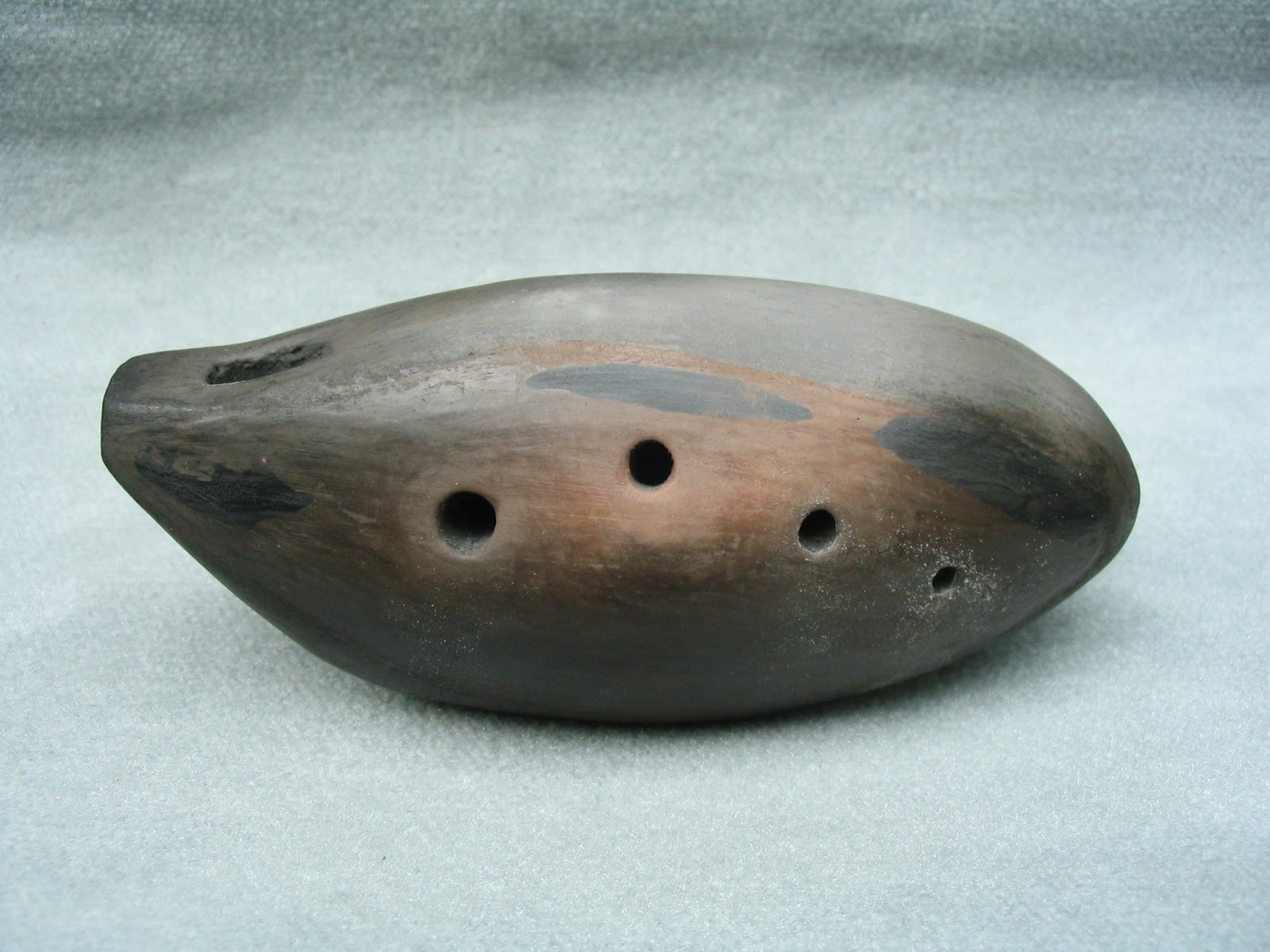
My remade, resurfaced ocarinas and ideophones complete, I set myself to the chore of updating my archive.  Every time I get behind on updating my archive and it becomes too time consuming, I wonder why I allowed myself to be talked in to creating this digital library of my work.  But when it is complete and I can set about making new work I find myself grateful to the person who suggested the ultra-organized museum catalogue.  Despite that, I do sometimes forego processing things like small beads and such.  I do have my limits.
Keeping things in order does take time away from my preferred work, but having an image, a measurement and a date for everything at my fingertips sometimes grants a return on that time.  It is good not to have to hunt something up when a gallery or client wants to see it.  And it makes my online shop much easier to manage.

When my archive is updated, I get a very satisfied feeling of things being neat and clean - the feeling I get when the bed is changed with fresh sheets that I slide between after showering off the dirt of the day.  Keeping things up is indeed a challenge though, and best done steadily in small increments rather than all at once.  My recent experience with waiting too long to organize reminded me that virtual clutter can be just as demoralizing as the material form. 
To celebrate the updated order, I’m posting the last before and after photographs of my remade ocarinas.  Easter will soon be upon us and these things look rather egg-like after all, with their natural smoke based swirls and speckles.


March 10, 2016

Little Birds

My graphic designer and good friend recently wrote a series of remarkable children’s stories.  We toyed with the idea of having me illustrate them, which I will probably do at some point.  This was generous of her because most publishers of children’s books have their own in house illustrations with whom they contract to illustrate their manuscripts.  But my friend was familiar with my work and felt that it dovetailed so well with her literature that she was willing to forego some protocol and take a risk with publishers on making her own preferences known.
I was in the midst of preparing the final illustrations for a very long book of my own poetry and at the beginning of a new series of wild and wooly big drawings.  But I did find the time to look through my notebooks of drawings that I had made at a natural history museum in Scotland some time ago.   I recalled that some of the drawings I had made of their specimens of birds might be applicable to the stories my friend wrote.  I found these and revised them into more complete illustrations.  Instead of having the birds awkwardly propped up on specimen stands, I added twigs and branches to make them a little more lively.  Before filling in the backgrounds, I scanned just the subject so that if they are eventually used in a publication there will be more flexibility in formatting.
The finished products with the backgrounds filled in were a slight departure from my decorative, imaginary illustrations as they were based on actual birds.  They were also not in the format that my friend will eventually need: 5" x 7" portrait style.  These ended up being 4" x 6" landscape. No bother.  They served as examples.  And so I posted them on my Etsy site for sale while granting my friend permission to use them.

March 9, 2016

Cat Got Your Tongue

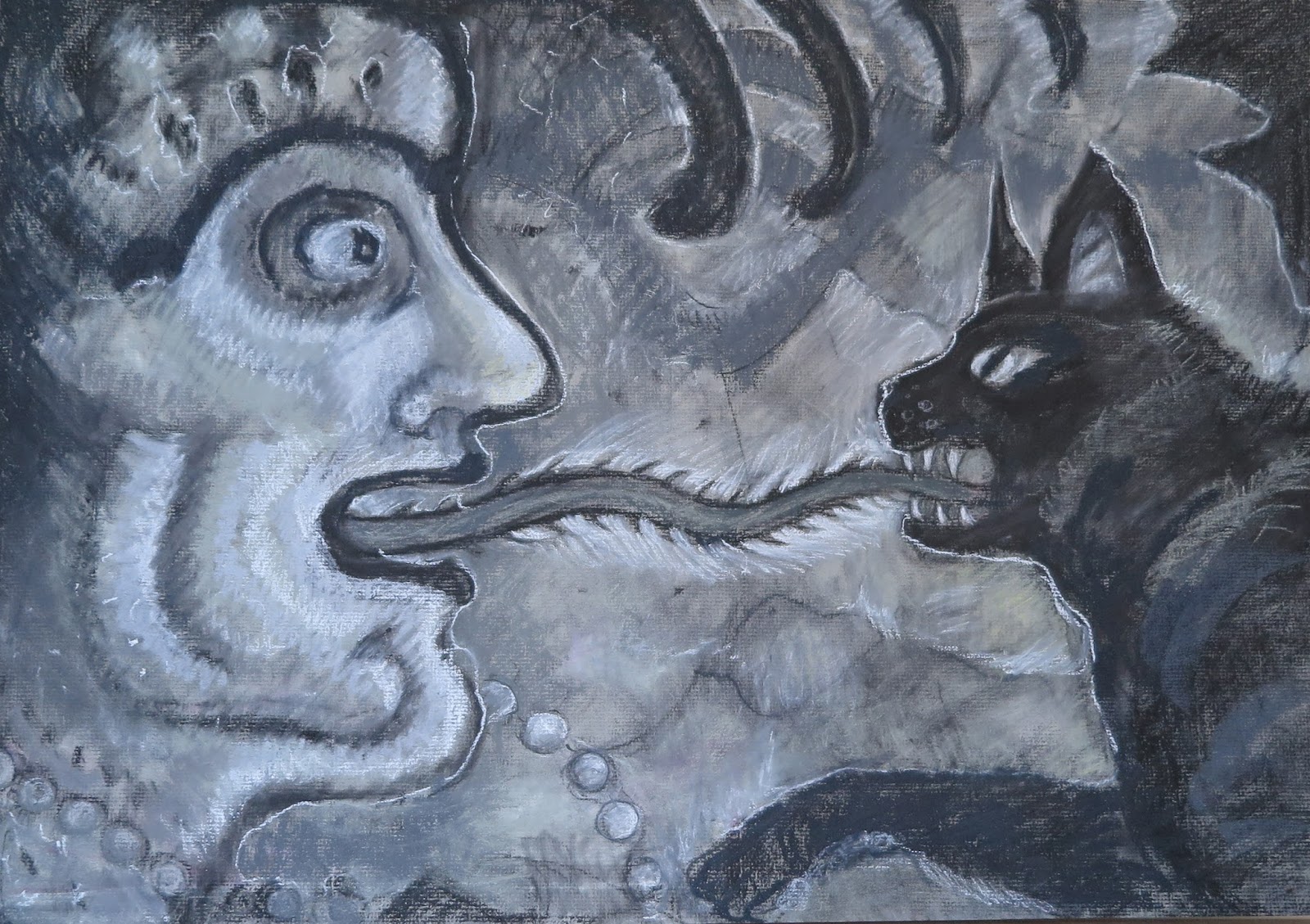
Almost four years ago, I had an idea about making large drawings graphically depicting commonly used idioms about bodily sensations.  I thought to start with the phrase, “the cat’s got your tongue.”    Such idioms as “it makes my skin crawl” and “I get all choked up” carry special associations as well.  What would it look like on paper to have these strange expressions made corporeal?
I finally got started on this project.  I suppose that part of my hesitation was because as an artist for hire, I do need to bear in mind that my work should have some potential commercial viability.  What clients would like to have a large expressionistic drawing of a cat biting someone’s tongue hanging on their wall?  Not many I think.  But when I get a notion about an art work that I would like to create, I never really feel settled until I eventually bring it in to being, anyone else wishing to actually acquire it notwithstanding.
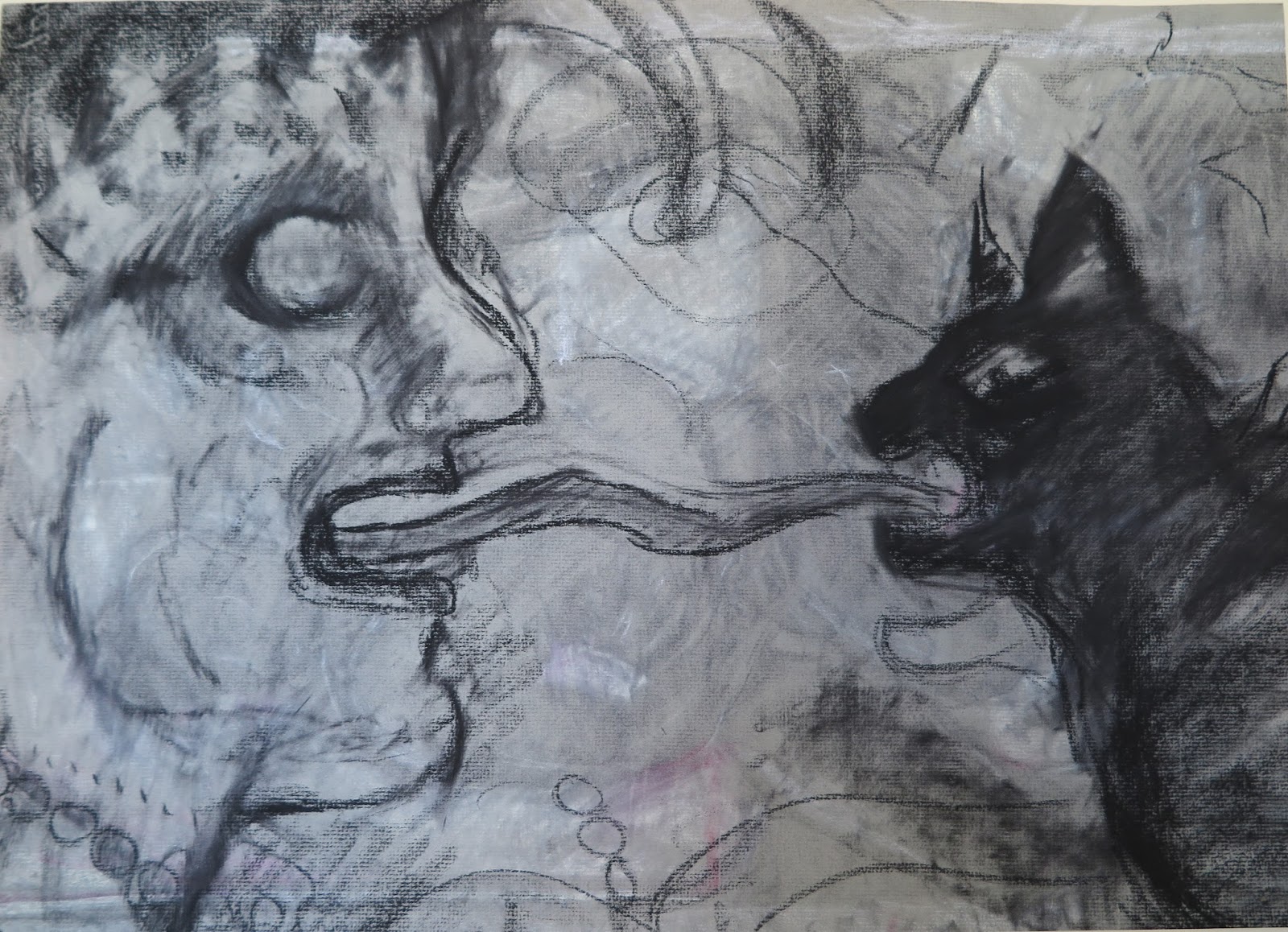
For “The Cat’s Got Your Tongue” I rummaged up an unfinished drawing from my graduate school days that I could recycle.  Most people throw such things away but I keep them if the paper they were rendered on was expensive.   Saves me the expense and trouble of ordering more paper for something experimental.  The other plus to using recycled drawings, especially pastel or charcoal, is that this under drawing can be smudged and erased in a way to create an interesting texture from which to work. 
The drawing I selected was of a model seated on a bench next to a plant.  My short little attention span had not allowed me to finish it at the time.  The first thing I changed was the orientation.  I turned the drawing from portrait style to landscape, as it was better that way for two entities to occupy that space: cat and person.  After that I judiciously smudged and erased the drawing, leaving an all over texture that reminded me of textiles, wires, or grass spikes. 
Over this I blocked out two forms; a person with a long tongue and the cat biting it.  But wait!  This did not fit my vision.  Why?  The problem was too much space at the lower half of the composition.  It made the tongue too high on the picture plane and it needed to be center or slightly lower than center and it was the focus of interest. So I could erase everything and draw it over again.  Or just crop the picture down.  I chose the latter.


The cat biting a person’s tongue was now settled in to the right space.  The joy of fleshing them out, adding tonality and details made the drawing come to life.  Bodily Idiom Drawing number one, “The Cat’s Got Your Tongue” was complete.  Satisfied with the results, I ordered 100 oversize plastic drawing sleeves and an archival box.  This will house the rest to come.


March 4, 2016

The Cat Came Back

A large sculptural  rattle in the shape of a cat that I made from an experimental clay started disintegrating after firing.  I tried to save it at first, but then decided that he probably was not salvageable.  But I could not quite bring myself to break him up, bag him up and toss him away.  As a sculpture with eyes, ears and an open mouth that seemed to be begging for mercy, something moved me to allow a friend to take him off my hands.  Apparently he is still slowly disintegrating on her bookshelf.
I did like the primitive look of the rattle so I made it again, one third the original size and with a clay that I had previously used successfully.  I put the same white terra sigillata glaze on the sculpture, burnished it and added some oxide stains.  Letting the smoke of the pit fire have its own will, the sculpture was finished with grey and black swirls, imparting an antiquing effect. Restitution for the foolishness of using an untested clay in a previous incarnation of this form.

March 3, 2016

A Little Box of Local Treasures

What does one do with three dimensional art forms that are too small to be sculptures but too large to be jewelry?  Call them art objects, perhaps, and find a suitable way to display or store them.  The small pit fired ceramic sculptures I had made fall into that category.  They could be beads, but as pit fired ceramics they may be a little too delicate to be functional, wearable art.  But they are not quite large enough to make an impression as a sculptural objects.  So what to do with them?
Although art object might be the right technical category for such things, I like to call my small sculptures “art toys.”  They are toys because their size and shapes invite a person to set them up in various configurations and groupings.  Their flattened edges enable the player to turn them on their multiple edges so that they can stand different ways.  One can imagine them as sculptures but if they were to function as such, they would have to be large enough for a viewer to see their multiple aspects by walking around them.  Instead, their aspects are revealed through manipulation.
I recall that as a child my favorite types of toys were things that came in multiples and were housed in  cleverly shaped boxes; a plastic farmhouse filled with small animals, a hollow chicken filled with eggs, a wooden box for wooden blocks.  I do believe that artists sometimes recreate in adult life the things that we were enamored of in our youths.  In this regard, a box full of precious little things holds an attraction for me.  The need to put my smaller art work in to an appropriately designed container was satisfied by making a ceramic lidded vessel for my beads/sculptures/art objects.
 In fashioning this ceramic box, I used the same clay mined from the Edisto that I had used to make my miniature sculptures.  Alluding to what was to be housed within, I made a knob in the shape of these sculptural pieces.  I purposely made everything asymmetrical so that the lid only fits on one way.  I made the surface smooth and polished with terra sigillata thinned out in areas so that the raw, orange clay would show through.  This was  bisque fired then put aside for a month until my recent pit firing.
Both the ceramic box and the little clay objects were local products.  Not only was the clay mined locally, but everything that went in to the pit fire was local as well -down to the very camellia flowers from my front and back yard that were used to smother the fire.  Creating a reduction atmosphere with expended flower blossoms was a new experiment for me.  The results were rounded smoke designs rather than the linear ones created by the previously used Spanish moss.  The effect was satisfying and I will probably try this again.

February 29, 2016

Zebra or Just Another Breed of Horse? A Medical Maxim Examined for Rare Disease Awareness Day


 Zebra, or an Unrecognized Horse?  A Medical Maxim Put to the Test
“If you hear hoofbeats, don’t think zebras.”
-Medical School Maxim
Many in the medical community have heard the commonly bantered about medical school maxim, “If you hear hoofbeats, don’t think zebras,”  dissuading newly minted doctors from seeking a diagnosis of a rare disease for patients with unusual symptoms not explained by routine, standardized tests.  The maxim never made much sense to me.  For one thing, as a metaphor it falls rather flat and as a maxim it lacks the resonance of truth.  Why wouldn’t someone think of zebras when hearing hoofbeats?  Why not wart hogs, cattle, antelopes, giraffes, or any such bovine or quadruped in possession of hooves?  Horses are not the only animal that make hoofbeat sounds when they run.
Finding the origins of truisms can often shed some light on how they came in to being and how they may have become popularized, generally accepted over time, and eventually distorted.  What I found about the zebras and hoofbeats medical maxim is that it apparently originated with  Dr. Theodore Woodward in the 1940's.  Dr. Woodward had an excellent reputation as a diagnostician and was a well-respected medical school professor.  Interestingly, the phrase about zebras and hoofbeats used today is a distortion of what Dr. Woodward actually said, that being “Don’t look for zebras on Green Street.”  At the very least this statement does make more sense as an aphorism because while it is true that a zebra makes hoofbeat sounds, it is not likely that a zebra would present itself on a street in downtown Baltimore.   How would this phrase become distorted over time, becoming misapplied in such a way as to be a potential source of under diagnosis and misdiagnosis of human disease?
Everyone has probably heard at one time or another, of  the whispering parlor game.  Several people are seated in a row and a sentence is whispered to the first person, who then whispers it to the next person, who then whispers it to his neighbor, and so on, until the last person in the row is reached.  This last person then stands up and says out loud what had been whispered to him.  The first person says the original statement out loud and everyone has a good laugh at how distorted the sentence became over several whisperings. 
Perhaps in the same way, a maxim repeated over several decades gradually loses its original intent as modifications and omissions distort it in to a fragmentary misinterpretation.  The playwright Henrik Gibson, in his play “An Enemy of the People” perhaps reflected this best through his character Dr. Stockman:
“A normally constituted truth lives, as a rule, seventeen or eighteen years, at the outside twenty, seldom longer, after which it presumably becomes a lie, a ghost.”
Maxims can become distorted with time and retelling.  What else may be at work to give a maxim a shelf life?  Time itself brings new discoveries in to being.  A new social paradigm can make earlier beliefs no longer apt.  In the case of the “hoof beats and zebra” maxim, medical knowledge about diseases once considered rare but are no longer found to be so erodes the analogy in an increasing number of cases.  One such example is interstitial cystitis, once thought to be a very rare disease of post menopausal women.  But decades of patient advocacy, networking and fund raising for research has changed medical understanding of the disease to include both men and women of all ages in the diagnosis, as well as a significantly higher prevalence in the general population than originally thought.  Such is the changing paradigm of a disease that loses its “zebra on Green Street” status.  In fact, I would hold that many, if not most, so called rare diseases are simply under-diagnosed.  Something rarely looked for is rarely found.
Did the “zebra on Green Street” analogy, then, ever have any use, and if so, what might that have been and why?  There is a use in medicine for training towards the  counter intuitive.  A surgeon must train to overcome the natural instinct that cutting in to a living human being’s flesh is a force of destruction.  An emergency room doctor who recoils with horror at an accident victim instead of setting immediately and dispassionately to work would not be of much use.
 Research suggests that the human mind intuitively recalls with greater acuity that which is unusual or extreme than those things that are ordinary and mundane.  Perhaps that is just one of the brain’s defense mechanisms - strange things impress more deeply because something that is out of order can be a threat worthy of instant recall.   By extension a medical student confronting a patient with a rare disease would remember that patient more vividly than the one who presents with a common cold.  The suggestion here is that the novice diagnostician must use trained reason to counteract the possibility that a rare disease memory will cause him to somehow “hallucinate” this disease recurring in a larger population than is the medically accepted norm.  And that is where the “zebra on Green Street” maxim comes in to play.  It was originally intended to protect a patient from unnecessary tests and possible inappropriate treatments through the mind’s error of over inclusion.
But what if seeing a disease in a larger population than is the medically accepted norm, is in fact the correct perception?  As medical knowledge increases, the trend seems to be precisely a discovery of higher than originally accepted prevalence of the so-called rare diseases.  Even discounting the probable actual higher incidence of individual rare diseases, it might do well to consider that if the current figure of approximately  6000 recognized rare diseases is correct,  odds are that a given population will have a distribution of these.  And diagnoses of exclusion are therefore somewhat suspect, for the sheer volume of possibilities makes a full exclusion rather unlikely.  Some of factors involved in impediments towards excluding rare diseases: www.ncbi.nlm.nih.gov/books/NBK56184/
Given what medical science knows today, rare diseases may indeed be much more common than the possibility of seeing a zebra on Green street.  Perhaps we need a new metaphor to describe them and a counter maxim as an antidote to the errors of exclusion promulgated by a maxim in need of retirement.  Maybe a person with a disease considered to be rare is more like an uncommon breed of horse, or even a not so uncommon breed of horse destined to live in an era in which only a limited number of horse breeds are recognized.  I sometimes think of myself not as a zebra in a world of horses, but as a Shetland Pony in a world that only sees the more common quarter horses, American painted horses, Arabian and Appaloosa.  Is there a possible aphorism as an antidote to the zebra on Green Street?  Something light hearted that is an equally apt metaphor for the error of under inclusion? I think so.  It might be something like, “If you hear hoofbeats, don’t assume that it can only be an American painted horse in your grandmother’s barn in Alabama.”

February 28, 2016

Rare Disease Awareness Day

The last day in February has been designated Rare Disease Awareness Day.  Since this year February has an extra last day, I have decided to write two entries acknowledging the event.
Since being diagnosed with Ehlers-Danlos last year, I have been astounded at the time it took to obtain the diagnosis, the persistent misunderstanding of the ailment in the medical community and the lack of awareness of its existence in the general population.   Fellow patients often make the same observation, a diagnosis after years of a search for answers to devastating health problems leading to the question, “What took so long?”
 I reflected on the amount of time and effort required in my own diagnoses.  (There are two disorders considered rare and perhaps more to come!)  In reviewing what was required to obtain a diagnosis and all the stumbling blocks that I encountered along the way, I came up with two antithetical lists; one for what impeded progress and the other for what set things on course towards identifying the cause of medical problems.   With proper time, effort and research every item on either list could be a treatise for rare disease awareness.  For now my time and research is limited but I will begin with this enumeration followed by commentary, some for this month and the rest for later.
 Unlike the popular adage that good news should come first, I like the problem first then solution later approach.  My list on the side of impediments begins with number one:
1. Symptoms are misinterpreted as benign features rather than hints at or actual markers for disease.
In my case, this happened twice, both with my tritanopia as well as my Ehlers-Danlos.  The main diagnostic marker for Ehlers-Danlos is marked joint flexibility and often silky or doughy skin that is hyper-elastic.    Pronounced flexibility in itself is often  a benign and often advantageous thing.  My nine-key reach was great for piano.  My flexibility was wonderful for dance, yoga, gymnastics and marshal arts.  But with Ehlers-Danlos the flexibility that creates advantage is unfortunately a sign of a connective tissue disorder.  Joints are loose because the collagen that comprises the  tendons and ligaments that hold bones in place is defective.  For reasons that may still be unclear, the illness can also result in autonomic nervous system damage, chronic severe headaches, cardiac problems, gastro-intestinal problems, and chronic fatigue.  For those who are not too fatigued to be active, activity often results in subluxations, torn tendons and dislocations.  It can become an incredibly painful disease. 
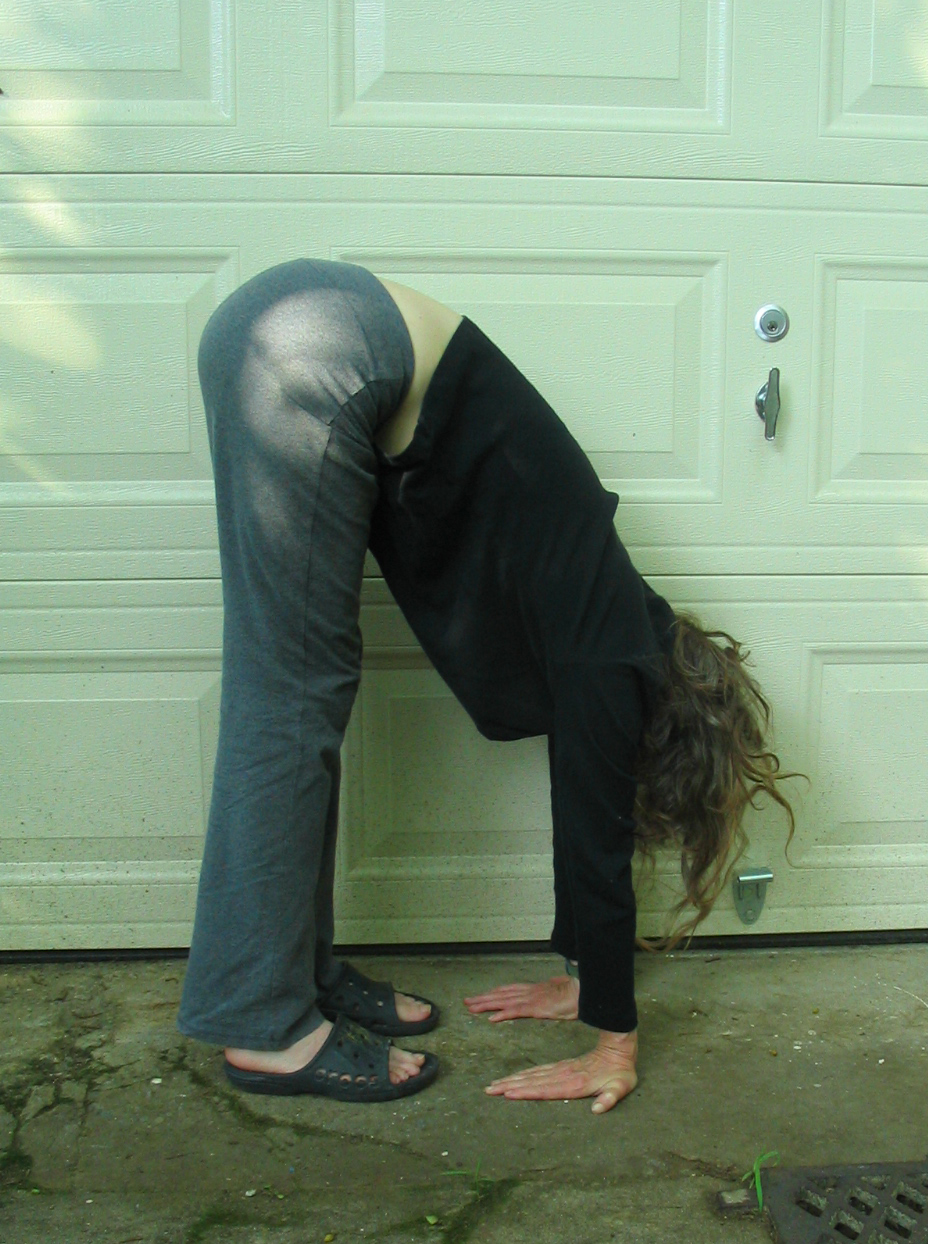
I never thought of my hyperflexibility as a symptom, even after becoming disabled.  It took a long time to connect the dots to connective tissue disease.   No doctors ever asked about joint laxity, and since I thought of it as a characteristic rather than a symptom, I never mentioned it.  The criteria for Ehlers Danlos Syndrome flexibility has traditionally been the Beighton scale, a list of nine or so point of  joint laxity in the thumb, small finger, back, elbows, and knees. It seems like a silly measurement, as many people are flexible way beyond the norm in areas outside of these markers but not always within them.  And there seems to be little accounting for age related arthritis diminishing flexibility.  Nevertheless, other than the geneticist who finally diagnosed me, there were no doctors in my care (I must have seen at least twenty or so during the five year course of this illness) who had heard of the Beighton scale or knew how to apply it.  Well, there was one doctor who thought he had tested me for hyper flexibility by coming in to my room at the hospital, wiggling the thumb of my right hand and then leaving the room.  That hardly counts.
Ironically, until the diagnosis of Ehlers Danlos seemed imminent, I had not realized the extent of my skin elasticity and joint laxity myself.  I looked at pictures of Ehlers Danlos patients and thought what looked like circus freak shore acts were anatomically impossible until I tried them myself and found that I could do all of them, and then some.  I never knew, for instance, that I could bend my thumb forward to touch my wrist until I looked at an EDS photo and saw that patients can do that.  Why would anyone want to?  But it does explain now why other patients have to have that little plastic ID bracelet cut off when they leave the hospital.  Not me.  I just dislocate my thumb and pull the bracelet up and over it.
For the past several months, every now and then I insinuated my Ehlers Danlos skin and joint features in to my art work.  The flexible thumb and tongue made their way into a small ceramic Harpy rattle.  The skin that pulls out over my eyebrows became a peculiar detail in a self portrait for the last illustration of my poetry chapbook, My Women My Monsters.  The last poem and illustration for this text became, fittingly, My Monster Myself.  It seemed the perfect euroboric way to end that story.  But the search for answers to the rare disease patients’ plaintive cry “why did it take so long?” is the beginning of my next story.


February 27, 2016

Would that Clay Could Look Like Wood

I sent a picture of my recently finished pit fired ceramic bowl to a friend.  “It looks like wood,” she commented.  Excellent, I thought.  I have always loved wood turned vessels but had not the resources to collect them personally.  In an effort to emulate the objects of desire I experimented with burnished vessels made from local clays that already had a cedar or oak like coloring.  The browns, pinks and whites were from the Santee area.  The orange and reds were from the Edisto.
The red clay from Edisto was slumped in a plaster bowl shape and then altered with carving in the leather hard stage.  The surface design was created by burnishing the clay surface, bisque firing, then smoke firing in the pit.  Instead of doing the usual metal box within the outdoor kiln to house this bowl, I placed the bowl directly into the ashes and let various and sundry burning organic matter fall onto it.  Since the fire was kept burning for several hours, an ash glaze began to form.  The finished product is pictured above.
For the smaller bowl, I took the brownish red clay from Santee and kneaded it together with the buff white in order to create a marbleized effect.  After smoothing out the surface of the bowl, the variegated clay was revealed by scraping the bowl down.  This bowl was placed in the tin container inside the pit kiln - I wanted to smoke it but not have it go so black that the design would be obscured.  The combination of small dots of black and the slight browning of the design imparted the overall effect of a bowl carved from a wood burl.  Success!
I once heard that many sculptors like to work in clay because ceramic is the great imitator of visual art.  Indeed, one can make it look like brick, stone, and sometimes even wood.